
Workman A28
4.5Editor score
PL-259 connectors
Side ground screw
Simple inline installation
This guide compares the top ten ham radio lightning protection for antennas to help you select the best surge arrester for your station and coaxial equipment.
Protecting your ham radio station from lightning strikes is essential for maintaining equipment safety. Quality protection devices divert high voltage energy safely to ground while preserving signal integrity during storms.
We compared ten real products based on construction quality, insertion loss, frequency range, and grounding features. Each item offers reliable surge protection for various antenna systems and connector types.
Every pick shows key specs, pros, cons, and practical use cases for your setup. Prices change frequently so check current listings before purchasing to ensure you get the best value.
4.5Editor score

4.8Editor score

4.8Editor score
This side-by-side comparison shows key specifications for all ten surge protectors to help you match the right device to your antenna system needs.




The XRDS-RF UHF Lightning Arrestor is a highly rated protector designed for CB and Ham radio stations. Its low loss and strong build make it a favorite for operators wanting reliable surge protection.
We may earn a commission when you buy through this link, at no additional cost to you.
This unit delivers low RF insertion loss under 0.4dB and VSWR below 1.2 across DC to 500MHz. The brass nickel plated body with Teflon insulator ensures durability in outdoor environments.
Installers note the female to female PL-259 connectors simplify inline coax work. The only trade-off is that a ground cable is not included so you must source one separately.
Choose this arrestor if you need a cost effective way to shield radios from electrical surges. It balances performance and construction quality for most base antenna setups.
Its low insertion loss ensures your transmit and receive signals remain clear without degradation through the protector.
The brass construction resists corrosion and handles repeated weather exposure without failure or signal leakage.
We may earn a commission when you buy through this link, at no additional cost to you.
The Diamond Antenna SP1000 is a robust arrester designed for mobile and base station antennas. It offers high surge capacity and replaces elements easily after a strike.
We may earn a commission when you buy through this link, at no additional cost to you.
Its impulse wave discharge capacity reaches 6000 Amps with over 10000M ohms insulating resistance. The replaceable surge arrester element ensures long term protection without replacing the whole unit.
Some operators may find it pricier than generic options but the replaceable feature offsets that. The weather resistant design suits vehicles and towers exposed to rain or dust.
Opt for the SP1000 when you need a durable solution for mobile or outdoor stations. Its replaceable parts and high surge rating make it ideal for active operators.
The replaceable surge element extends the life of your protector after it diverts a major lightning surge.
With 6000 Amp discharge it handles severe weather events without damaging your connected radio equipment.
We may earn a commission when you buy through this link, at no additional cost to you.
The Workman A28 offers an affordable lightning protection solution for CB and Ham radio base antennas. It includes a side ground screw for quick connection to your grounding system.
We may earn a commission when you buy through this link, at no additional cost to you.
Each end has PL-259 Male and Female connectors for easy inline installation. The design focuses on diverting surges between the radio and antenna without complex features.
This unit lacks detailed specs like insertion loss but remains reliable for basic setups. Its compact size fits neatly near your radio or antenna tuner.
Choose the Workman A28 if budget is your priority. It delivers core surge protection for operators needing a simple inline arrester.
The side ground screw and standard connectors allow quick setup without tools or complex wiring.
Low cost makes this a practical choice for stations where advanced specs are not required.
We may earn a commission when you buy through this link, at no additional cost to you.
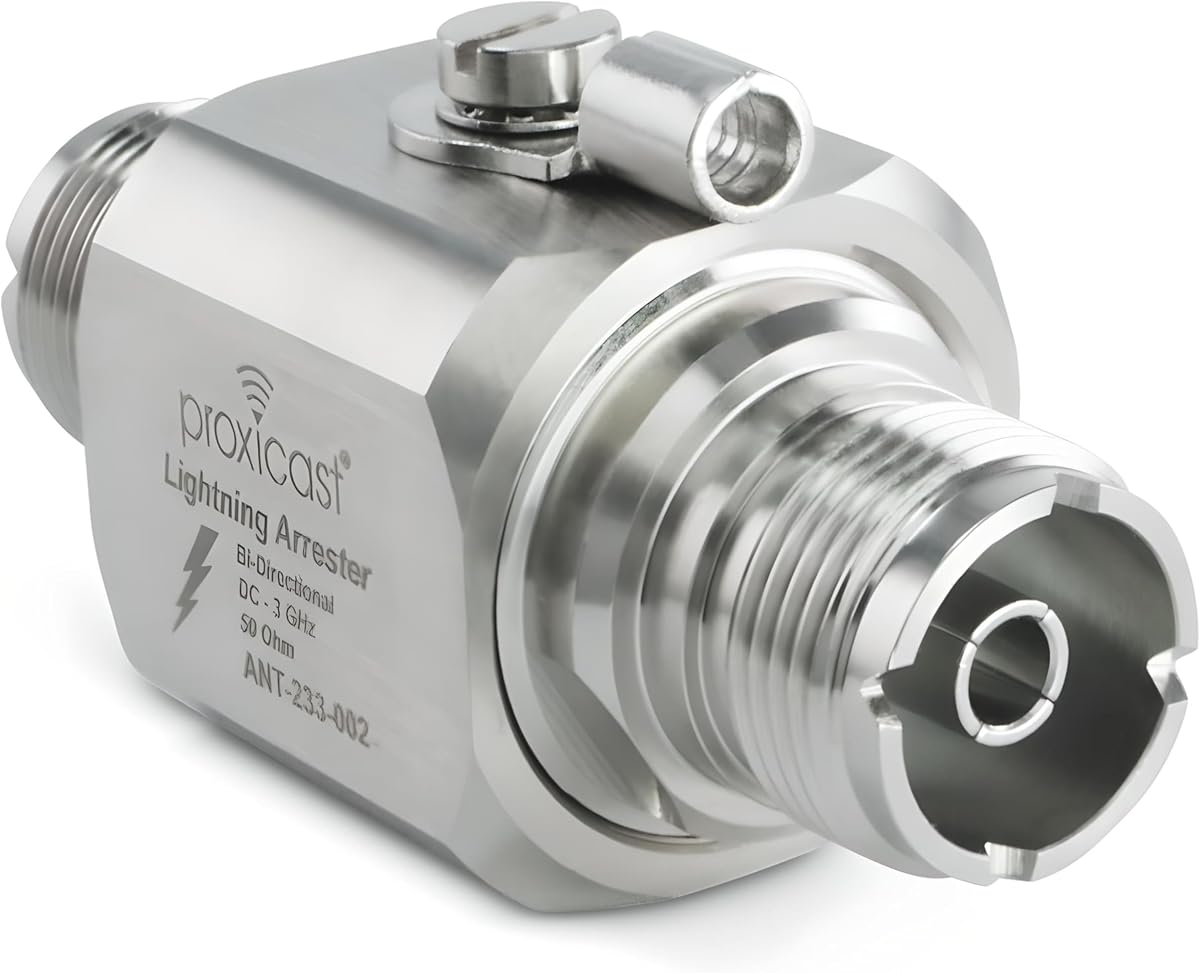
The Proxicast ProGrade arrester is designed for VHF UHF and amateur radios using SO-239 connectors. Its bi-directional design protects against surges from either direction.
We may earn a commission when you buy through this link, at no additional cost to you.
It features a 230V gas discharge tube that shunts damaging transients to ground. The outdoor rated build suits in-line use in enclosures or weather exposed mounts.
Installers appreciate the DC pass-through which keeps continuity when not striking. It may cost more than generic arrestors but offers reliable bi-directional coverage.
Select the Proxicast ProGrade if your station uses SO-239 connectors. It delivers durable multi-strike protection for VHF and UHF base systems.
Surge protection works from either direction protecting both the radio and antenna sides equally.
The 230V tube provides fast response to surges ensuring your coax and radio stay safe.
We may earn a commission when you buy through this link, at no additional cost to you.
The UHF Surge Protector earns a top user rating for reliable defense against lightning and power surges. Its aluminum housing offers excellent heat dissipation for sustained use.
We may earn a commission when you buy through this link, at no additional cost to you.
The female to female PL259 design allows quick series connection into existing antenna feedlines. Included earth lead secures to grounding terminals for activation.
Users note its sturdy build handles weather exposure without degradation. The only limit is that it ships as a single piece which may cost more for bulk needs.
Choose this protector when you want a highly rated solution with corrosion resistant construction. Its aluminum body ensures longevity in harsh outdoor conditions.
The aluminum housing dissipates heat efficiently keeping internal components cool during surges or transmission.
Standard connectors and included earth lead mean you can install it without extra tools.
We may earn a commission when you buy through this link, at no additional cost to you.
The Diamond Antenna SP3000 protects stations using N-Type connectors across DC to 3000MHz. It handles 200W power and diverts surges with a 1000V impulse capacity.
We may earn a commission when you buy through this link, at no additional cost to you.
This arrester features replaceable surge elements so you can maintain protection after a strike. Its wideband performance suits HF VHF and UHF bands in a single device.
Users praise its low loss and durable construction. While N-Type connectors may require adapters for some setups the coverage and reliability justify the cost.
Opt for the SP3000 if you use N-Type connectors and want wideband protection. Its replaceable parts ensure long term safety for your gear.
Supporting DC to 3000MHz ensures your arrestor works across most amateur radio bands.
Replaceable surge elements keep your station protected for years without replacing the entire unit.
We may earn a commission when you buy through this link, at no additional cost to you.
The XRDS-RF Bulkhead Arrestor simplifies coax entry through enclosures using an integrated nut and PL-259 to SO239 transition. Its 230V gas tube diverts surges to ground.
We may earn a commission when you buy through this link, at no additional cost to you.
Low insertion loss under 0.4dB and VSWR below 1.2 preserve signal quality across DC to 500MHz. The nickel plated brass body resists weather exposure.
Installers note the bulkhead design keeps cables neat in control boxes. Users mention it works well for base stations needing clean cable management.
Choose this arrestor if you need a bulkhead feedthrough with surge protection. Its integrated nut ensures a secure fit in your setup.
The integrated nut allows secure mounting through a panel or enclosure for tidy cable routing.
The 230V gas tube ensures harmful energy from strikes is safely grounded without affecting signal.
We may earn a commission when you buy through this link, at no additional cost to you.
This two pack of Coaxial Lightning Arrester units offers reliable protection for multiple setups or backup stations. Each uses gas discharge tubes to divert sudden surges safely.
We may earn a commission when you buy through this link, at no additional cost to you.
Brass nickel plated outer conductors improve abrasion resistance while PTFE insulator protects the inner core. The design suits GSM satellite GPS and Ham radio applications.
Users appreciate the flexible installation through enclosure walls. The two unit pack provides better value for multi antenna systems needing multiple protectors.
Opt for this pack if you need to protect several coax lines. It delivers reliable surge protection for diverse RF and communication systems.
Buying two arrestors at once saves cost and ensures spare units for multi antenna setups.
Supports GPS GSM satellite and Ham radio applications across various antenna configurations.
We may earn a commission when you buy through this link, at no additional cost to you.
The RAIGEN Lightning Arrestor provides protection from zero to six GHz for IoT WiFi LoRa and Ham radio systems. Its less than 0.1dB insertion loss keeps signals strong.
We may earn a commission when you buy through this link, at no additional cost to you.
A replaceable 90V gas discharge tube allows continued protection after a surge. Weatherproof construction and a ground lug ensure safe permanent outdoor mounting.
Installers value its heavy duty brass nickel plated body for all weather use. While premium priced it covers more frequencies than most amateur arrestors.
Choose RAIGEN if you need wideband protection across many devices. Its professional build ensures reliable defense for mixed use stations.
Supporting zero to six GHz ensures your arrestor protects everything from CB to WiFi and LTE signals.
Less than 0.1dB insertion loss means minimal impact on your signal strength.
We may earn a commission when you buy through this link, at no additional cost to you.
The Opek LP-350a protects radios up to 350 Watts across 0 to 600MHz. It accepts PL-259 connectors and includes a ground terminal for surge diversion.
We may earn a commission when you buy through this link, at no additional cost to you.
This unit handles static and lightning surges for CB Ham and two-way radios. Its design focuses on protecting equipment from electrical interference rather than data.
Users find it practical for high power stations needing reliable protection. While bandwidth is lower than some models the power rating suits classic base setups.
Choose the Opek LP-350a for higher power stations. Its static protection and ground terminal deliver essential safety for your coax line.
Handling up to 350W ensures it works well with powerful transmitters without damage.
This arrester also guards against static buildup which can harm sensitive electronics.
We may earn a commission when you buy through this link, at no additional cost to you.
Selecting the right lightning protection involves matching the arrestor to your connector type, frequency range, and grounding options.
Ensure the arrestor uses the same connectors as your coax and antenna. Common types include PL-259 SO-239 N-Type and F-type mismatched connectors cause signal loss or leaks.
Check both ends of the arrestor before purchasing to confirm a direct fit.
Choose an arrestor covering your operating bands. UHF models handle up to 500MHz while wideband units reach 3000MHz or 6GHz for modern IoT setups.
A broader range protects future equipment upgrades without needing replacements.
Lower insertion loss keeps your signals strong. Look for under 0.5dB for general use or below 0.1dB for weak signal work.
High loss can degrade receive sensitivity and reduce transmit range.
Proper grounding is essential for surge diversion. Select arrestors with side ground screws or ground lugs to bond easily to your ground system.
Ensure your station has a proper earth ground before installing any protector.
Outdoor rated arrestors use nickel plated brass or aluminum housings with PTFE or Teflon insulators. These resist corrosion and weather over years.
Check for UV resistant coatings if installing near exposed roofs.
Some high-end arrestors allow replacing the gas tube or arrester element. This feature extends the life of the unit after a strike.
Consider models with replaceable parts if you experience frequent storms.
Arrestors rated for multiple strikes can handle repeated surges. Look for specs mentioning multi-strike or impulse discharge ratings like 6000 Amps.
This durability ensures long-term protection without frequent replacements.
Ensure the arrestor matches your transmitter power. Higher Watt models protect high-power stations better than general ones.
Impulse ratings indicate how much surge energy the device can divert safely.
Install the arrestor inline between your outdoor antenna and indoor radio. Keep it as close as possible to the entrance point of the building.
Connect the ground lug or screw to a dedicated grounding rod or system. Use short thick ground wires for best performance.
Inspect arrestors after heavy storms. Replace any unit with visible damage or if surge protection has been activated repeatedly.
Yes any station with an outdoor antenna should use surge protection. Lightning and static strikes can damage radios coax and equipment even without a direct hit. An arrestor diverts high voltage to ground.
Arrestors protect against induced surges and nearby strikes not direct hits. For direct protection use lightning rods and proper station grounding. Arrestors divert energy from the coax line to ground safely.
Disconnecting the antenna is the safest option but arrestors provide continuous protection. Use arrestors plus a ground switch if you prefer to disconnect during severe weather.
Insertion loss is signal weakening caused by the protector. Lower values mean better signal strength. Look for under 0.5dB for good performance across your operating bands.
Some arrestors have replaceable tubes or elements. Others must be replaced entirely. Check the product specs to see if the device supports part replacement after surge diversion.
Only if the connectors match. Use arrestors with the same connector type as your coax ends like PL-259 or N-Type to avoid adapters and signal loss.
This guide presented ten reliable arrestors for CB Ham and base antennas with strengths in loss construction and bandwidth. Models like the Diamond SP3000 and RAIGEN offer wideband options while the Workman A28 serves budget needs.
Focus on connector match frequency range and proper grounding for the best results. Replaceable and multi-strike models add value if you face frequent storms.
Prices and stock vary so check current listings before buying. With the right arrester your station stays protected from damaging electrical surges.