
FNIRSI HRM-10
4.4Editor score
Color TFT display
Historical data export
Wide voltage range
This guide compares the top ten battery internal resistance testers for accurate voltage and health diagnostics across automotive and electronics applications.
Finding the right battery internal resistance tester ensures accurate diagnostics for automotive and electronic systems. These devices measure resistance alongside voltage to reveal true battery health beyond simple charge levels.
We evaluated ten real products based on accuracy, range, display quality, and usability. Each entry includes verified specifications and features to help you choose the best tool for your specific testing needs.
Every pick highlights standout capabilities and trade-offs for informed decisions. Note that prices and availability change frequently so always check current listings before purchasing any featured device.
4.4Editor score

4.5Editor score

2.2Editor score
The following table provides a side-by-side comparison of all ten featured models showing key specifications and capabilities to simplify your selection process.




The ZOYI ZT-XR1 stands out as a versatile tool combining a True RMS multimeter with battery resistance testing. Its 25000 count display delivers exceptional detail for precise diagnostics across automotive and electronics applications.
We may earn a commission when you buy through this link, at no additional cost to you.
It features dedicated 4-wire Kelvin sensing for accurate low-resistance readings essential for evaluating battery health. The interface supports bilingual menus and adjustable power settings making it adaptable to diverse workflows and environments.
While more expensive than basic testers it justifies the cost with professional grade features like waveform recording and self-calibration. Users should note the learning curve for full functionality compared to single-purpose devices.
This model suits technicians who need both general measurement and battery analysis in one unit. Its robust construction and safety ratings ensure reliability during demanding repair and maintenance tasks.
By integrating multimeter functions you reduce equipment needs and carry weight during field repairs.
The Kelvin sensing eliminates lead resistance errors critical when testing small internal battery values.
We may earn a commission when you buy through this link, at no additional cost to you.
The FNIRSI HRM-10 delivers reliable battery diagnostics at an accessible price point. It automatically measures resistance and voltage simultaneously with a vivid color display that enhances reading clarity.
We may earn a commission when you buy through this link, at no additional cost to you.
Its Kelvin four-wire connection method minimizes contact errors for accurate low-resistance values. The device stores eight historical test sets allowing batch comparison which speeds up evaluation of multiple batteries.
Users must stay within the 100V DC limit and avoid AC voltage to ensure safety. While lacking general multimeter capabilities it focuses well on battery health assessment for cost-effective maintenance.
Ideal for hobbyists or small shops needing focused battery testing without overspending. The straightforward interface and export options make data tracking manageable for routine checks.
The HD color layout makes quick interpretation of test results easier than monochrome alternatives.
Historical record storage helps track battery degradation over time without external logbooks.
We may earn a commission when you buy through this link, at no additional cost to you.
The T-685 offers laboratory-grade precision with one micro ohm resolution and broad voltage ranges for advanced analysis. It supports AC and DC resistance modes making it versatile for diverse research and industrial needs.
We may earn a commission when you buy through this link, at no additional cost to you.
Designed with intelligent testing capabilities including fast-paced measurements and automatic range switching it reduces manual intervention. The USB port enables computer connectivity for logging and deeper analysis of test data.
Despite its technical prowess the device carries a high price and lower user satisfaction which may limit adoption outside professional labs. Users should verify compatibility with specific battery chemistries before purchase.
Best for specialized applications requiring micro-level resolution not found in standard testers. Its compact design and AC power options suit fixed bench setups over mobile field use.
One micro ohm capability reveals minute internal changes critical for high-end battery pack optimization.
USB port integration supports automated data collection for comprehensive battery performance tracking.
We may earn a commission when you buy through this link, at no additional cost to you.
WESTOBIG battery tester focuses on automation with preset gears and automatic mode to speed up testing workflows. It includes Kelvin clips for accurate measurements and supports exporting records to Excel for analysis.
We may earn a commission when you buy through this link, at no additional cost to you.
The ability to preset eight data sets helps identify problematic batteries quickly against set standards. Its color display ensures clear visibility of results which reduces errors during high-volume battery checks.
Users must handle AC voltage carefully and stay within DC limits to avoid damage. The reliance on clips may slow testing compared to probe-only units but improves contact stability.
This model works well for workshops needing consistent automated checks without manual calculation. Its design balances precision with usability for general automotive and household battery maintenance.
Auto mode reduces manual range selection allowing rapid sequential testing of multiple battery units.
Direct transfer to PC via Excel supports formal reporting and long-term quality control reviews.
We may earn a commission when you buy through this link, at no additional cost to you.
Dlyfull universal tester simplifies battery checks with a rotary dial selecting from eleven common types directly. It displays capacity percentage and voltage which helps decide replacement needs without technical expertise.
We may earn a commission when you buy through this link, at no additional cost to you.
Test leads connect to the battery so insertion into bays is unnecessary enhancing portability. The device runs on inserted test batteries ensuring no internal power issues affect operation during storage.
Accuracy focuses on health estimation rather than detailed micro ohm resistance values. Users should match the dial setting carefully to battery type to avoid incorrect readings or damage.
Best for home users managing household devices where quick checks suffice. Its compact size and clear screen make it ideal for toys remote controls and small electronics maintenance.
Rotary dial selection removes complexity allowing immediate tests without navigating digital menus.
Percentage display offers intuitive health status for quick replacement decisions without detailed logs.
We may earn a commission when you buy through this link, at no additional cost to you.
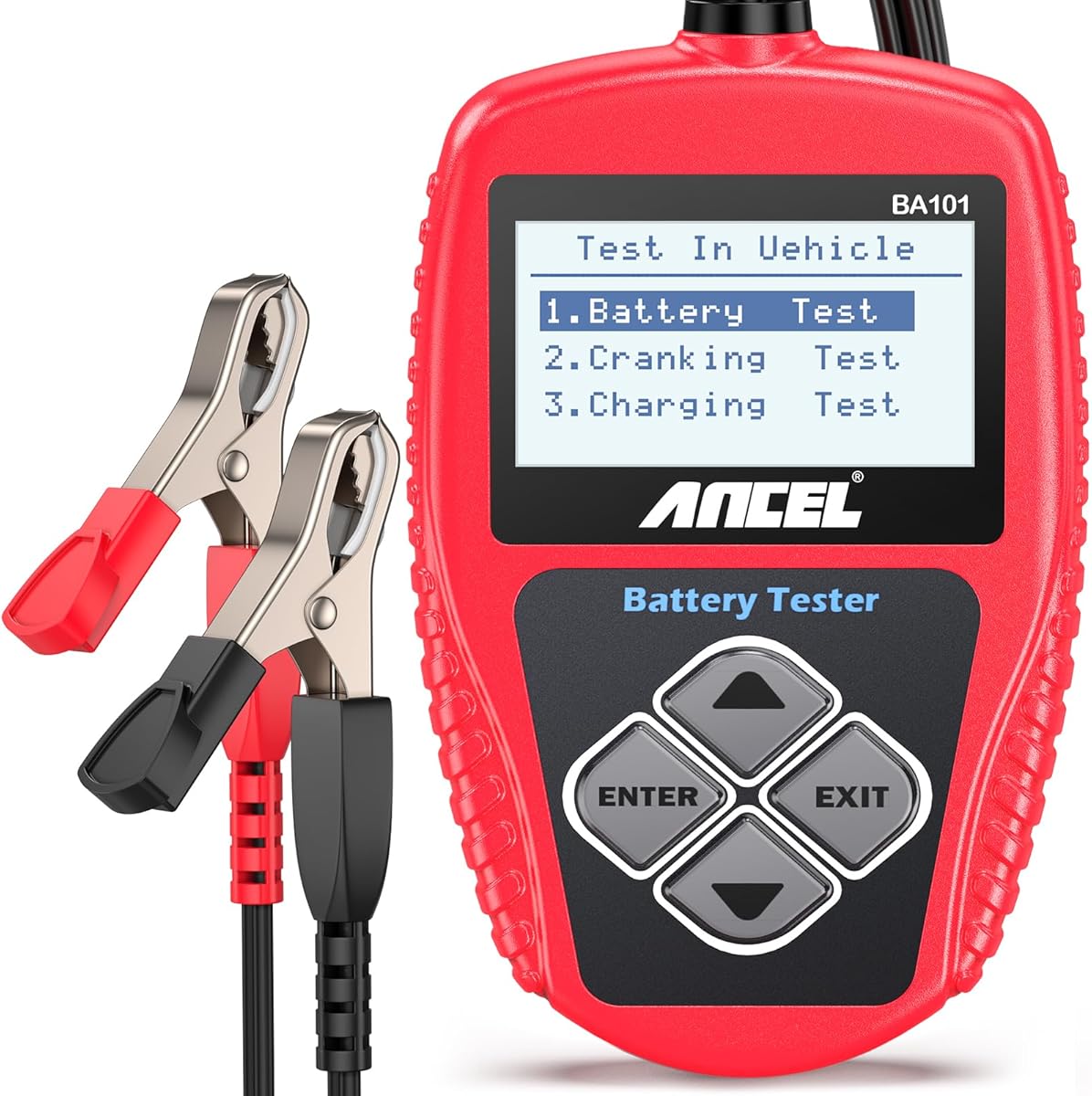
ANCEL BA101 specializes in 12V automotive battery diagnostics offering detailed state of health and charge readings. It supports global standards and multiple battery types including AGM and EFB for accurate vehicle testing.
We may earn a commission when you buy through this link, at no additional cost to you.
Built-in protection guards against reverse polarity and overcurrent making it safe for roadside use. The classic screen with adjustable contrast ensures visibility in bright sunlight or dark garages during checks.
Limited to 12V systems excluding lithium or higher voltage batteries like 24V truck setups. Users must enter correct battery labels for precise results which adds a small step before testing.
Perfect for mechanics and vehicle owners needing reliable car battery insights without a multimeter. Its durability and multi-language support enhance usability across diverse automotive service environments.
State of health and charge metrics give a full picture beyond simple voltage checks.
Multiple protection layers prevent damage to tester and vehicle during accidental wiring errors.
We may earn a commission when you buy through this link, at no additional cost to you.
ZOYI XR1 merges resistance testing with general multimeter functions for a compact two-in-one solution. Its TFT color screen displays voltage and resistance clearly and it supports Type-C charging for convenience.
We may earn a commission when you buy through this link, at no additional cost to you.
Users benefit from configurable auto power-off and buzzer volume to suit workshop or field needs. The dual port design minimizes signal interference during complex testing on sensitive electronics.
Lower ratings suggest variability in performance or durability compared to premium models. Users should calibrate regularly and verify readings against known standards to maintain confidence in results.
Suitable for DIY hobbyists needing basic multimeter and battery checks in one portable unit. Its design prioritizes versatility over extreme precision for general maintenance tasks.
Having both multimeter and resistance tools in one case reduces gear needed for general repairs.
Type-C interface ensures compatibility with common chargers and reduces need for legacy power adapters.
We may earn a commission when you buy through this link, at no additional cost to you.
RC3563 combines intelligent control with Kalman filter algorithms for high precision battery analysis. It measures internal resistance and voltage together with a handheld design ideal for portable testing across research and maintenance.
We may earn a commission when you buy through this link, at no additional cost to you.
Its built-in 1000mAh battery supports field work with convenient USB charging. The device handles various battery chemistries including lead lithium and NiCd for broad application flexibility.
Limited runtime requires careful planning for long testing sessions without recharging. Users should expect shorter screen size that may reduce detail compared to larger units.
Best for technicians needing portable accurate analysis without bench equipment. Its efficiency and low power design make it suitable for frequent battery checks during production or repair workflows.
Kalman filter algorithms improve measurement stability for accurate readings despite noise or fluctuations.
Lightweight handheld form factor enables easy transport between testing stations without bulky setups.
We may earn a commission when you buy through this link, at no additional cost to you.
YR1035+ Plus provides reliable four-wire testing for accurate resistance and voltage measurements across battery types. Its large LCD screen delivers real-time results supporting quick decisions in screening and configuration tasks.
We may earn a commission when you buy through this link, at no additional cost to you.
The compact design makes it easy to carry between workbenches or field sites. Users report high satisfaction due to consistent performance and ease of use for standard diagnostic needs.
It lacks advanced multimeter functions and advanced analytics found in premium units. Those needing deeper data analysis may find the straightforward display limiting for complex workflows.
Best for technicians prioritizing accuracy and simplicity in routine checks. Its design suits both lab environments and field use where portability and reliability are essential for daily work.
True four wire testing eliminates lead resistance ensuring precise low ohm readings for health checks.
Lightweight build allows effortless transport for on-site assessments without compromising stability.
We may earn a commission when you buy through this link, at no additional cost to you.
YR1035 Accessories expand testing versatility with square clamps for various battery terminals and types. It measures resistance and voltage across lithium lead-acid and button batteries with Type-C charging for modern power options.
We may earn a commission when you buy through this link, at no additional cost to you.
The clamp design frees hands during testing improving efficiency when handling multiple battery units. Users appreciate the universal compatibility reducing need for multiple dedicated testers in inventory.
Setup may require understanding accessory configurations to optimize accuracy for specific terminals. Some users find the interface basic compared to newer models with enhanced digital features.
Ideal for labs needing flexible testing across diverse chemistries. Its high rating reflects reliability and adaptability making it a practical choice for varied battery maintenance programs.
Square clamps simplify connection to varied battery terminals reducing setup time during checks.
Type-C charging aligns with current standards for easier power management across devices.
We may earn a commission when you buy through this link, at no additional cost to you.
Selecting the right tester requires balancing accuracy range usability and budget. Here are essential factors to consider before making your purchase.
Accuracy is critical for diagnosing battery health accurately. Look for devices with 4-wire Kelvin sensing which eliminates lead resistance errors especially for low ohm values common in batteries.
Prioritize testers with proven precision specs like below one percent error for reliable results in professional settings.
Ensure the tester covers the voltage and resistance ranges you need. Most models support up to 100V DC and 200 ohms which suits automotive and electronics.
Confirm compatibility with your battery types to avoid limitations during testing sessions.
Clear displays improve reading speed and reduce errors. Color TFT screens offer better visibility than monochrome ones especially in varying light conditions.
Adjustable brightness helps in harsh environments ensuring consistent usability.
Features like data logging and PC connectivity help track battery health over time. Export options enable deeper analysis essential for warranty or research needs.
Consider units with built-in memory or cloud support for organized test records.
Portable units rely on internal batteries so rechargeable lithium types with Type-C charging are preferred for convenience.
Check runtime ratings to ensure adequate use between charges for your workflow.
Safety features like reverse polarity and overvoltage protection protect both user and device during testing.
Look for CAT ratings matching your voltage exposure to prevent electrical hazards.
Balance cost with necessary functionality. Entry-level testers suffice for basic checks but professionals may need multi-function units with higher precision.
Invest in models that align with your specific testing frequency and complexity.
User interfaces should be intuitive with adjustable settings for different tasks. Auto modes simplify repetitive testing reducing manual steps and errors.
Choose designs that fit your hand well for comfort during extended use.
Always begin by calibrating the tester if supported. Connect leads securely to battery terminals using proper polarity to avoid errors or damage.
Select the appropriate range mode either manual or auto depending on your needs. Allow the unit to stabilize before reading values to ensure accurate results.
After testing store the device in a dry clean place. Clean contacts regularly and recharge internal batteries as needed to maintain longevity and performance.
It measures the opposition to current flow inside a battery indicating health and aging. Low resistance suggests good condition while high resistance signals wear or failure.
This method separates current and voltage leads to eliminate lead resistance errors. It ensures precise low ohm readings critical for accurate battery diagnostics.
Most support lithium types like 18650 but always check voltage limits. Avoid using on non-specified chemistries to prevent damage or unsafe readings.
Compare measured internal resistance against manufacturer specs. Higher than recommended values indicate degradation and need for replacement.
Wear protective gear and ensure batteries are disconnected from circuits. Never exceed rated voltage limits to avoid electrical hazards or device damage.
Many models support PC connectivity via USB or Bluetooth for exporting logs to Excel. This aids tracking performance trends over time.
Accuracy varies but quality units offer less than one percent error with proper calibration. Always verify against known standards for critical applications.
Yes most handheld models are lightweight and powered by internal batteries for field use. Their compact designs fit easily into tool kits for on-site testing.
We highlighted ten reliable testers covering diverse needs from budget-friendly to premium accuracy. Each offers distinct features balancing precision usability and versatility for various applications.
Prioritize accuracy and safety features if working with critical systems. For routine checks focus on ease of use and portability to streamline maintenance tasks.
Prices and availability fluctuate so review current listings before buying. Verify compatibility with your battery types and confirm warranty terms for confidence.