
Riiai SG003A
4.4Editor score
4-20mA current signal
USB rechargeable battery
TFT color display
Compare the top Amfm Signal Generator models for 2026. This guide reviews features, performance, and use cases to help you choose the right signal source.
Finding the right Amfm Signal Generator is crucial for electronics enthusiasts and professionals alike. These devices produce precise waveforms needed for testing circuits and verifying equipment performance across various industries.
We evaluated ten leading models based on frequency range, modulation types, and build quality. Our analysis considers portability, user interface, and compatibility with modern testing standards to ensure reliable results.
Each selection highlights unique strengths tailored to specific needs like lab work or field maintenance. Note that product availability and pricing may fluctuate, so verify details before making a final purchase decision.
4.4Editor score

5.0Editor score

5.0Editor score
This side-by-side comparison breaks down the key specifications of each model to help you identify the best fit for your specific testing requirements and budget constraints.




The UNI-T UTG962E stands out as a top-tier choice for engineers needing reliable waveform generation. With a perfect 5.0 rating, it delivers exceptional value through its robust performance and portable form factor.
We may earn a commission when you buy through this link, at no additional cost to you.
Its 60 MHz frequency range and 200 MS/s sample rate ensure precise signal output for complex testing scenarios. The dual channels allow for simultaneous testing of different circuits without additional equipment.
While it offers extensive modulation types like AM, FM, and PM, the non-volatile storage is capped at 24 arbitrary waveforms. This is sufficient for most standard applications but might limit highly specialized research.
Ideal for electronics enthusiasts and field technicians, this generator combines power with convenience. It is a strong recommendation for anyone needing a versatile tool without benchtop bulk.
Supports AM, FM, PM, and FSK modulation for diverse testing needs including radio frequency analysis.
Offers linear and logarithmic scan types to perform comprehensive signal analysis from low to high frequencies.
We may earn a commission when you buy through this link, at no additional cost to you.
The OWON DGE2035 focuses on precision with its 14-bit resolution and stable dual-channel output. Rated 4.2, it suits environments where signal clarity and detailed visualization are priorities over raw frequency speed.
We may earn a commission when you buy through this link, at no additional cost to you.
Features like the 3.6-inch TFT LCD and built-in arbitrary waveform library make it user-friendly for lab testing and education. Remote control via USB adds flexibility for automated testing sequences.
The limitation in frequency output compared to other models might restrict use in high-frequency RF applications. However, for standard function generation tasks, it remains a reliable and portable choice.
Best suited for research labs and educational settings, this generator balances cost and performance effectively. It is a practical option for those prioritizing display quality and remote management.
The 3.6 TFT color screen displays real-time waveform status and menu settings for easier operation.
Allows storage of up to 16 non-volatile digital waveforms for quick recall during testing sessions.
We may earn a commission when you buy through this link, at no additional cost to you.
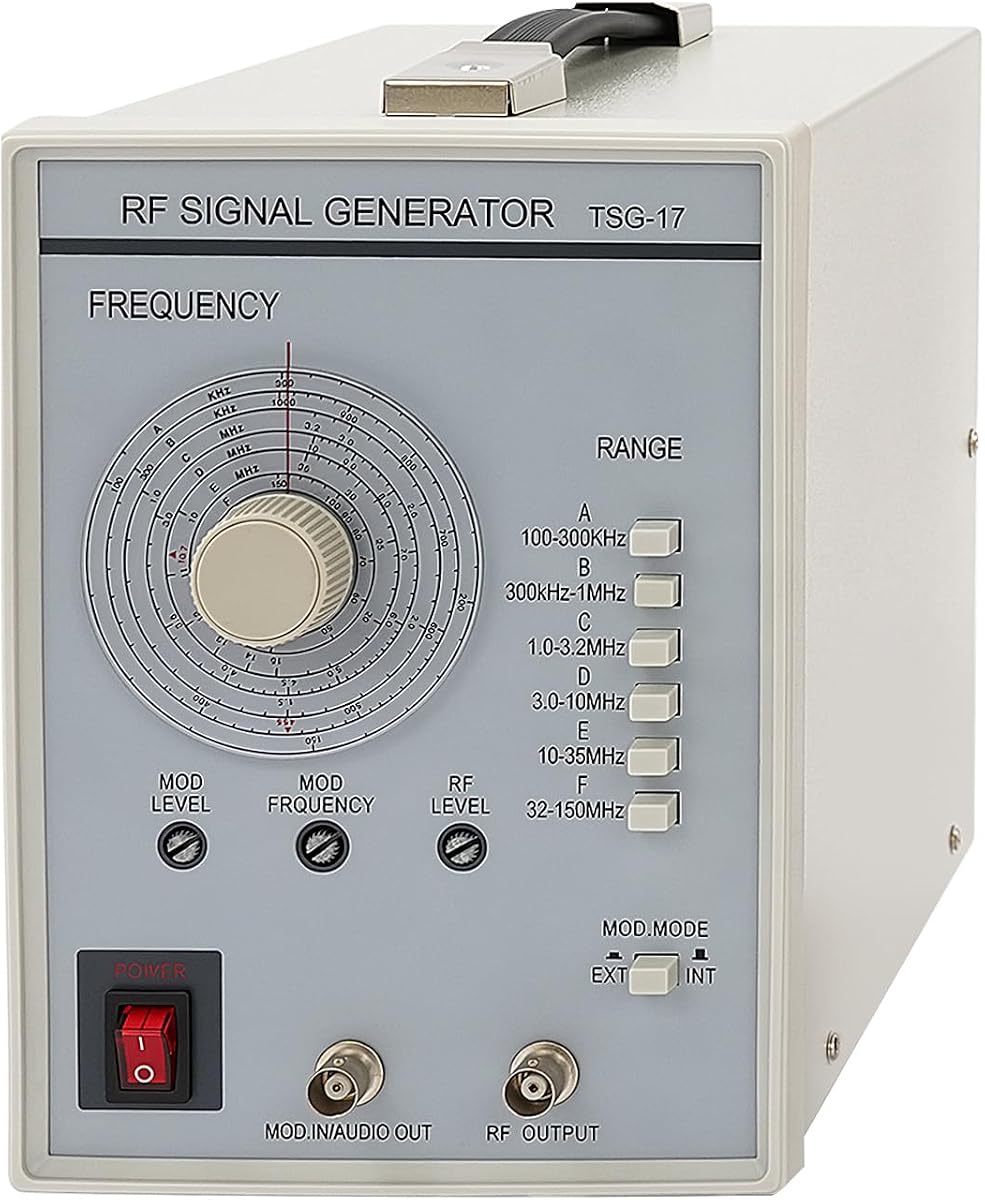
Designed for radio testing and maintenance, this 6-Band generator offers a broad frequency range from 100KHz to 150MHz. Its low phase noise ensures signal purity essential for accurate diagnostic results.
We may earn a commission when you buy through this link, at no additional cost to you.
The sturdy metal construction and scratch-resistant finish make it ideal for demanding workshop environments. Simple knobs and buttons allow for quick operation without extensive training or complex menus.
Lacking a digital display means users must rely on physical scales for frequency selection. This analog approach may slow down workflow but ensures reliability in harsh conditions where screens might fail.
This tool is best for technicians focusing on equipment maintenance and repair. It provides straightforward, robust performance without unnecessary features, making it a solid workhorse for field operations.
Low phase noise characteristics effectively ensure the purity of the signal and reduce interference.
High-class metal and plastic spraying process ensure the product is sturdy and impact-resistant.
We may earn a commission when you buy through this link, at no additional cost to you.
Covering a massive range from 35MHz to 4400MHz, this generator is designed for applications requiring high-frequency signal sources. It is suitable for testing wireless components and modern communication systems.
We may earn a commission when you buy through this link, at no additional cost to you.
The ability to save parameters when powered off saves time by recalling previous settings instantly. Users can power it via mobile charger or PC, adding to its portability during field tests.
However, users should note the low output power and presence of some noise in the sine wave. This makes it less ideal for precision lab work but acceptable for general signal verification tasks.
For hobbyists or technicians needing broad frequency coverage at a budget price, this unit offers significant utility. It bridges the gap between basic generators and professional high-end RF equipment.
With 35Mhz-4400Mhz coverage, it is suitable for a variety of applications across different bands.
Powered by a mobile charger, power bank, or USB connecting to a computer for flexibility.
We may earn a commission when you buy through this link, at no additional cost to you.
The TSG-17 is a dedicated high-frequency generator designed for commercial and household radio testing. Its 100kHz to 150MHz range covers standard AM broadcast needs effectively with high accuracy.
We may earn a commission when you buy through this link, at no additional cost to you.
Operating on 110V mains power ensures stable output without relying on batteries. The ability to set external modulation signals between 50Hz to 20 KHz adds flexibility for modulation testing.
Lower ratings suggest potential reliability or performance issues compared to more robust models. Users may find it less versatile due to limited waveform options beyond sine and amplitude modulation.
For basic AM radio equipment maintenance, this model provides straightforward functionality. It serves a specific niche where mains power is available and complex modulation is not required.
Uses 110V high accuracy power supply for consistent performance during extended testing periods.
External modulation signal can be set between 50Hz to 20 KHz for customized testing.
We may earn a commission when you buy through this link, at no additional cost to you.
Tailored for industrial calibration, this generator handles 4-20mA current and 0-12v voltage signals accurately. It is an essential tool for verifying PLC inputs and industrial control loops.
We may earn a commission when you buy through this link, at no additional cost to you.
The inclusion of a lithium battery allows for portable use on the factory floor without outlet access. PWM output adjustment further extends its utility for testing frequency-dependent components.
Users should note that the voltage output is fixed to a specific range which may not suit all high-voltage requirements. Additionally, the absence of a digital readout requires careful manual calibration.
This device is recommended for industrial maintenance technicians who need a dedicated tool for loop testing. It simplifies the process of simulating sensor outputs without needing complex equipment.
Built-in 3.7V lithium battery generally takes more than 6 hours to charge and provides 1-5 hours use.
Includes short circuit protection and reverse connection protection to ensure safe operation during testing.
We may earn a commission when you buy through this link, at no additional cost to you.
The Riiai 0-10V model combines voltage and current generation in a single compact unit. Its high 4.6 rating reflects ease of use and accuracy for PLC and panel debugging tasks.
We may earn a commission when you buy through this link, at no additional cost to you.
A 4-digit display provides precise feedback on output values, ensuring accurate calibration. The ability to set nine fast signal output points speeds up repetitive testing scenarios significantly.
While the built-in battery is convenient, it has a moderate capacity compared to larger units. External power options like DC 15-30V help extend runtime during longer projects.
Ideal for technicians working on automation systems, this generator simplifies testing with its dual output capabilities. It is a reliable partner for ensuring panel components function correctly.
Voltage precision 0.01V and current precision 0.01mA ensure accurate calibration results.
4 different types of digit displays allow switching between voltage and current modes easily.
We may earn a commission when you buy through this link, at no additional cost to you.
As a leading budget option, the Riiai SG003A supports switching various signal modes including current and voltage. This versatility makes it an excellent choice for simulating sensor inputs in industrial settings.
We may earn a commission when you buy through this link, at no additional cost to you.
The large 3000mAh battery ensures up to 26 hours of working time, which is impressive for a portable unit. The colorful TFT screen enhances visibility and ease of use during long shifts.
Although it focuses on analog simulation, it lacks high-frequency waveform capabilities. This limitation is acceptable for users whose primary need is current and voltage loop testing.
For value-conscious buyers needing robust PLC testing capabilities, this generator delivers exceptional performance. Its battery life and screen quality elevate it above other low-cost alternatives.
Working length of up to 26 hours allows for a longer working period without recharging.
Input signal can be converted into an output signal among different physical quantities for simulation.
We may earn a commission when you buy through this link, at no additional cost to you.
The DROK generator is designed for simplicity, offering both ampere and voltage signal generation in one module. It is an effective tool for adjusting PLC panels and testing LED circuits.
We may earn a commission when you buy through this link, at no additional cost to you.
Control is achieved through a multi-cycle precise potentiometer, allowing for smooth adjustments. This mechanical approach ensures stability without the complexity of digital interfaces.
Users should be aware that settings are not stored digitally, requiring manual resetting after power off. This might be a minor inconvenience but keeps the device cost-effective and easy to repair.
Best for general electronics work where high precision is not the primary concern, this unit is a solid workhorse. It is recommended for hobbyists and technicians needing basic analog simulation.
Rotating a multi-cycle precise potentiometer generates the signal simply and handy.
Generates 0/4 – 20mA current signal and 0-10V voltage signal just by one module.
We may earn a commission when you buy through this link, at no additional cost to you.
The SEESII Dual Channel generator is a premium tool integrating multiple functions into one instrument. With a perfect 5.0 rating, it delivers high-precision testing capabilities suitable for advanced R&D.
We may earn a commission when you buy through this link, at no additional cost to you.
Its dual channels allow independent adjustment with adjustable phase difference, which is vital for synchronous circuit testing. The 60 built-in arbitrary waveforms provide extensive simulation options.
While the feature set is extensive, it may present a steeper learning curve for casual users. However, for engineers and technicians, the detailed pulse width control justifies the investment.
This device is best for serious practitioners requiring reliable and versatile signal generation. It stands out as a top-tier choice for university labs and professional electronic design.
Covers 0.01Hz to 30MHz frequency with ±20ppm frequency accuracy for precise testing.
Supports digital precise regulation of pulse cycle and pulse width for timing signals.
We may earn a commission when you buy through this link, at no additional cost to you.
Selecting the right generator depends on specific application needs such as frequency range, modulation types, and portability.
The frequency range dictates which circuits or signals can be tested. Ensure the generator covers the required bandwidth for your projects, such as RF or audio frequencies.
Check the minimum and maximum output limits to confirm compatibility with your devices under test.
Different applications require specific modulation schemes like AM, FM, or PM. Choose a unit that supports the necessary modulation to simulate real-world signal conditions accurately.
Verify support for advanced features like FSK or sweep functions if detailed signal analysis is needed.
Single or dual-channel capabilities allow for testing multiple signals simultaneously. Dual channels are beneficial for comparing phases or testing differential circuits.
Consider if independent control of each channel is required for complex experimental setups.
Field technicians need lightweight and compact units with battery power. Benchtop models offer more stability but are less convenient for on-site work.
Evaluate weight and battery life to ensure the device fits your workflow and location needs.
A clear screen with real-time waveform status simplifies setup and adjustment. TFT LCD displays often provide better visibility than older analog meters.
Look for intuitive interfaces that reduce the time needed to configure parameters during testing.
USB or PC control enables automated testing and data logging capabilities. Ensure the unit includes necessary cables for your computing setup.
Advanced users may prefer units with remote control options for integration into larger test systems.
Robust housing protects internal components from shocks and environmental factors. Metal casings are generally more durable than plastic alternatives.
Invest in a unit with short circuit protection to safeguard both the device and your equipment.
Balance the features offered against the budget to find the best value. Higher-priced models usually offer better precision and additional functions.
Assess whether basic features meet your needs or if premium capabilities justify the extra cost for your specific use case.
Start by connecting the power source and ensuring all cables are securely attached. Verify the device initializes correctly before sending any signals to your test equipment.
Set the desired frequency and modulation parameters using the provided controls. Use the display to confirm that the output matches your required settings.
Regularly clean the device and store it in a dry place to prevent damage. Keep firmware updated if applicable to maintain optimal performance and compatibility.
A signal generator typically produces basic periodic signals like sine waves. A waveform generator creates complex arbitrary waveforms for detailed testing needs.
Yes, many models cover ranges down to audio frequencies. Always check the minimum frequency output before purchasing for audio applications.
Some portable units have built-in batteries for field use. Others require AC power or USB connections, so verify the power options for your needs.
Dual channels allow simultaneous generation of two independent signals. This is useful for testing differential circuits or comparing phase relationships.
Select a generator that covers the maximum frequency of your target circuits. Ensure it also supports any necessary harmonic or higher-frequency tests.
Ensure proper grounding and check for short circuit protection to avoid damage. Follow user manuals to prevent electrical hazards during testing.
Many modern units support USB or Ethernet connections for remote control. Check the specifications to see if it includes PC software or API support.
Low phase noise ensures signal purity, which is critical for RF and precision testing. It reduces interference and improves the accuracy of your results.
The selected models offer a range of solutions from budget-friendly analog simulators to advanced digital generators. Each option addresses different user needs whether for lab work or field maintenance.
Prioritize frequency range and modulation support to ensure the device meets your testing requirements. Consider portability and ease of use for efficient daily operation.
Always verify current product details and availability before purchasing to get the best value. The right generator can significantly improve your testing accuracy and workflow efficiency.