
Fully Assembled Mini 3D Printer for Kids & Beginners
4.4Editor score
Fully assembled starter kit
High precision 0.01mm
250mm/s print speed
Discover the top 3D printers for kids in 2026. This guide compares safety, speed, ease of use, and educational features to help families choose the right model.
Finding the right 3D printer for kids requires balancing safety, ease of use, and creative potential. Parents want devices that inspire learning without complicated setups or risky hot surfaces. Modern models now include enclosed chambers and AI tools to simplify the design process for young makers.
We evaluated ten leading 3D printers based on safety certifications, print speed, and user-friendly software. Our comparison focuses on features like auto-leveling, enclosed frames, and educational libraries. We also considered how easily children can design and print objects independently.
Each pick highlights unique strengths like AI creativity, compact sizes, or robust educational modules. While our research is thorough, availability and specifications may shift over time. We recommend checking current details before purchasing to ensure the best fit for your family's creative goals.
4.4Editor score

4.5Editor score

5.0Editor score
This side-by-side comparison helps you identify key differences across speed, safety, and software features. Use these specs to match a printer to your child's skill level and your home environment needs.


The AOSEED AI 3D Printer for Kids stands out as a top choice for families seeking a safe and intuitive printing experience. It offers a robust enclosed design that protects young users from hot surfaces while delivering fast print speeds. The inclusion of AI tools simplifies the design process, making it accessible for beginners.
We may earn a commission when you buy through this link, at no additional cost to you.
This printer excels in its user-friendly app ecosystem, which provides access to over 8000 tested models. The AI Doodle feature allows children to transform simple sketches or voice prompts into 3D objects without needing complex CAD skills. Parents appreciate the real-time monitoring camera that lets them track progress remotely.
While the printer supports only single-color filament, users can create multi-color objects by printing parts separately and assembling them. This limitation requires a bit more creativity but does not hinder the overall fun. The build quality is solid, and the magnetic plate makes removing prints straightforward for kids.
We recommend this model for parents who prioritize safety and ease of use. It is ideal for kids aged 8 and up who want to explore STEM concepts through hands-on creation. The combination of safety features and creative tools makes it a strong educational gift.
Overall, the AOSEED AI printer balances performance with child-centric design effectively. It reduces the typical friction points of 3D printing like bed leveling and safety risks. This makes it a reliable long-term tool for fostering creativity and technical skills at home.
AI tools like Doodle and MiniMe allow kids to design without needing technical software skills.
Fully enclosed chamber and cool-touch exterior protect children from moving parts and hot surfaces.
We may earn a commission when you buy through this link, at no additional cost to you.
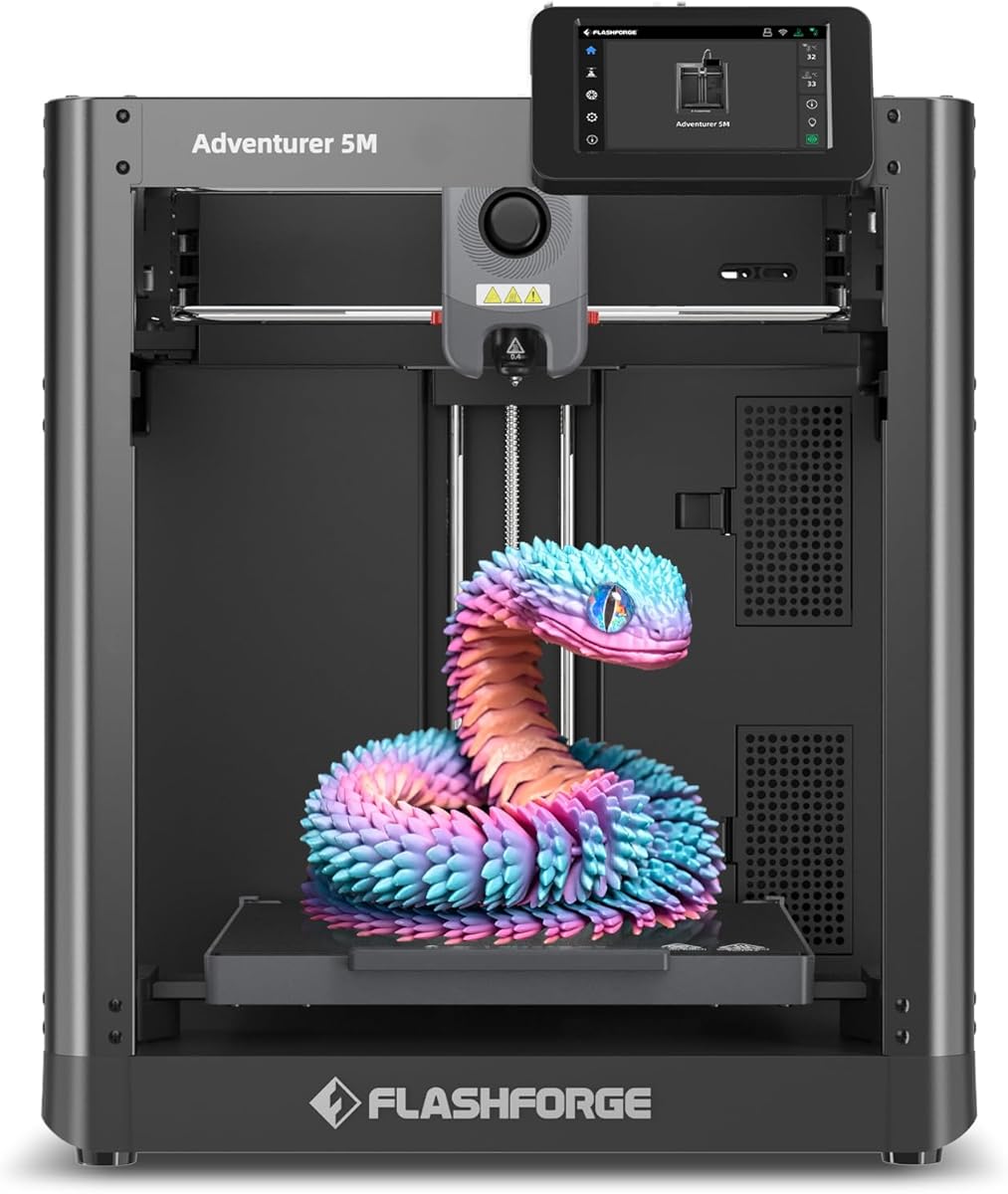
The FLASHFORGE Adventurer 5M is engineered for speed and precision, making it suitable for older kids interested in prototyping. Its CoreXY structure allows for high travel speeds without sacrificing accuracy. The auto leveling feature ensures the first layer sticks well, reducing failed prints significantly.
We may earn a commission when you buy through this link, at no additional cost to you.
With speeds reaching up to 600mm/s, this printer can complete projects in a fraction of the time of standard models. The detachable nozzle system simplifies maintenance, allowing users to swap nozzles in seconds. This is beneficial for those learning about mechanical adjustments in 3D printing.
However, the lack of an enclosure means hot parts are exposed, which might not be ideal for younger children. Parents will need to supervise usage closely. Additionally, the higher speed can generate more noise compared to quieter consumer models designed for bedrooms.
This printer is best for families where an older child or teen handles the machine with adult supervision. It offers a glimpse into professional-grade printing capabilities within a home setting. The robust build quality ensures durability for frequent use.
While it may require more oversight than fully enclosed models, the performance benefits are significant. Kids can learn about speed settings and mechanical adjustments while producing results quickly. It is a great stepping stone to advanced printing concepts.
CoreXY structure and high acceleration allow for rapid printing times on standard materials.
3-second nozzle changes and auto leveling minimize downtime and setup frustrations.
We may earn a commission when you buy through this link, at no additional cost to you.
The Entina Tina2C is designed specifically for beginners who want to start printing almost immediately. Fully assembled and easy to set up, it reduces the initial learning curve that often discourages new users. The guided setup process via the app helps kids understand the basics quickly.
We may earn a commission when you buy through this link, at no additional cost to you.
Its compact size makes it ideal for small desks or shared spaces without taking up too much room. The built-in WiFi control allows printing from phones or tablets, adding a modern touch to the experience. The model library offers plenty of creative projects for various age groups.
While the build volume is smaller than full-sized printers, it is perfect for small toys and figurines. This limitation keeps material costs down and print times short, maintaining excitement. The auto leveling system ensures consistent quality without manual adjustments.
This model is perfect for younger kids or those new to 3D printing who need a simple entry point. The focus on STEM learning provides structured activities that are educational and fun. It is a great addition to classrooms or home learning environments.
Overall, the Tina2C prioritizes user experience and convenience over raw speed. It removes the technical barriers often associated with desktop printers. For families looking for a low-stress introduction to 3D printing, this is a top contender.
Guided setup and auto leveling allow first prints within minutes of unboxing.
Small footprint fits easily on desks while maintaining print quality and reliability.
We may earn a commission when you buy through this link, at no additional cost to you.
This 3D Printer for Kids AI model focuses heavily on creative tools that empower children to design their own projects. The AI MiniMe feature can transform photos into cartoon figures, adding a personal touch to prints. It comes fully assembled, ensuring kids can start using it right away.
We may earn a commission when you buy through this link, at no additional cost to you.
The enclosed design is a major safety feature, preventing access to hot nozzles and moving parts. This allows parents to feel more comfortable when children operate the printer independently. The build plate is magnetic, making it easy for small hands to remove finished prints.
While it offers extensive creative freedom, the reliance on AI tools means an internet connection is often necessary. Some models may not be accessible offline, which could limit usage in areas with weak connectivity. However, the library of 8000+ models provides endless offline options.
We see this printer as an ideal gift for creative kids who enjoy storytelling and character design. It turns screen time into creation time, engaging imagination rather than just consuming content. The time-lapse camera feature adds an educational element by showing how prints are made.
For families prioritizing creativity and safety, this model offers a strong package. It simplifies the complex aspects of 3D modeling into fun interactions. The investment in safety and software tools pays off in long-term engagement.
AI features allow kids to create custom avatars and objects from simple inputs.
Enclosed chamber and cool exterior ensure safe usage for children at home.
We may earn a commission when you buy through this link, at no additional cost to you.
The AOSEED AI 3D Printer for Kids premium version offers an enhanced experience with ultra-quiet operation and advanced AI features. It includes premium STEM modules designed to teach engineering concepts through play. The 3.5-inch touchscreen simplifies navigation for users of all ages.
We may earn a commission when you buy through this link, at no additional cost to you.
With speeds up to 400mm/s and precision down to 0.05mm, it delivers high-quality results quickly. The built-in AI assistant guides users through setup and printing, reducing errors. This level of support makes it ideal for families who want a smooth experience.
The enclosed design ensures safety, while the magnetic build plate allows easy removal of prints. It comes with a set of high-quality filament rolls to start immediately. The power-loss recovery feature prevents wasted materials if electricity is interrupted during a long print.
This printer is perfect for households that value educational depth and noise levels. It is suitable for shared spaces like living rooms or bedrooms without disturbing others. The comprehensive software suite ensures that children remain engaged over time.
For those willing to invest in a top-tier device, the premium model provides the best balance of performance and education. It removes technical hurdles and focuses on creative and learning outcomes. It represents a significant upgrade in user experience.
Structured STEM courses help kids learn engineering and design concepts systematically.
Under 50 dB noise levels allow for printing in quiet environments like bedrooms.
We may earn a commission when you buy through this link, at no additional cost to you.
This Fully Assembled Mini 3D Printer offers an affordable entry point into the world of 3D printing. It comes with everything needed to start, including filament and an SD card. The high precision of 0.01mm ensures detailed results even on a budget.
We may earn a commission when you buy through this link, at no additional cost to you.
The auto nozzle cleaning feature helps maintain print quality without manual intervention. This is a significant convenience for beginners who may not know how to clean nozzles manually. The 250mm/s speed is respectable for home use and ensures projects finish quickly.
While it is a smaller printer, it is robust enough for home and school projects. The PEI heated bed makes removing prints easy, which is critical for maintaining confidence in young users. It is a practical choice for classrooms with multiple units.
We recommend this for families who want to test the waters without a large financial commitment. It offers reliability and ease of use at a competitive price point. The included accessories make it truly ready to use out of the box.
For budget-conscious shoppers, this printer delivers excellent value. It covers the basics of safety, speed, and precision effectively. It is a great tool for sparking interest in technology and design.
Includes filament and accessories so users can start printing immediately.
Auto nozzle cleaning and power-loss recovery reduce downtime and frustration.
We may earn a commission when you buy through this link, at no additional cost to you.
This AI-powered 3D printer is built with a strong focus on STEM education. It simplifies the design process with one-tap printing and intuitive interfaces. The enclosed design ensures that children can use it safely under minimal supervision.
We may earn a commission when you buy through this link, at no additional cost to you.
The time-lapse camera feature is excellent for teaching how prints are made layer by layer. It helps kids understand the physical process behind digital designs. The library of models is curated to support educational goals in math and engineering.
While the software is streamlined for ease of use, it may limit advanced customizability for older users. However, for the target age group, it is perfectly aligned with learning objectives. The build quality is durable, standing up to frequent handling.
We recommend this for parents looking to encourage technical skills through play. It offers a balanced approach between entertainment and education. The ease of use means less frustration for beginners.
Overall, it serves as an effective tool for introducing 3D concepts. It makes complex ideas accessible through interactive design. It is a worthy choice for households focused on STEM.
Curated tools and models specifically support STEM learning outcomes.
Time-lapse camera helps visualize the step-by-step creation process.
We may earn a commission when you buy through this link, at no additional cost to you.
The Entina Tina2C Mini 3D Bundle includes four colors of PLA filament, providing immediate creative variety. This saves the hassle of buying extra materials right away. The auto leveling and compact design make it easy to place on any desk.
We may earn a commission when you buy through this link, at no additional cost to you.
With 3000+ models and 20 DIY modules, the software offers plenty of variety for beginners. The app control allows for flexible printing workflows. Power-loss recovery ensures that long prints are not lost due to power outages.
While it lacks an enclosure, the build quality is solid for its size. It is best suited for supervised use or older kids who understand safety precautions. The quiet operation is a bonus for home environments.
This bundle is ideal for families who want a complete package without extra purchases. It simplifies the decision-making process by providing everything needed to start. It is a practical choice for casual hobbyists.
Overall, it offers great value for the price. It balances functionality with ease of use. It is a reliable option for those starting out in 3D printing.
Includes filament and accessories for immediate use without extra purchases.
App control and power-loss recovery provide a smooth and reliable experience.
We may earn a commission when you buy through this link, at no additional cost to you.
This 3D printer focuses on delivering a smooth user experience for families. It comes fully assembled and features a cool-touch exterior that enhances safety during operation. The magnetic build plate makes removing prints easy and consistent.
We may earn a commission when you buy through this link, at no additional cost to you.
AI design tools allow kids to create objects without needing complex software skills. The interface is designed to be intuitive, reducing frustration for new users. Regular updates ensure the model library stays fresh and relevant.
While it may lack advanced manual controls, this simplicity is beneficial for younger children. It allows them to focus on creativity rather than technical settings. The strong community support ensures help is available when needed.
We recommend this for households prioritizing safety and ease of use. It is a great tool for introducing kids to digital fabrication. The focus on simplicity ensures long-term enjoyment without technical barriers.
Overall, it is a well-rounded choice for families. It combines safety features with fun design tools. It is a reliable option for home creative projects.
Cool-touch exterior and magnetic plate ensure safe and easy handling.
Intuitive design tools simplify the creation process for beginners.
We may earn a commission when you buy through this link, at no additional cost to you.
The Bambu Lab A1 mini is a high-performance printer that simplifies setup with automatic calibration. It comes with an LED Lamp Kit for creative light projects. The ecosystem offers access to thousands of ready-to-print models.
We may earn a commission when you buy through this link, at no additional cost to you.
It is fast, quiet, and reliable, making it suitable for home use. The calibration system ensures consistent results right out of the box. This reduces the technical learning curve often associated with advanced printers.
However, it is not fully enclosed, which may require supervision for younger children. The price is higher than entry-level models, but the performance justifies the cost. It is a strong option for those who want reliability and speed.
We recommend this for families who want a robust device that grows with their skills. It offers a professional experience in a compact form. It is a great investment for serious hobbyists.
Overall, it stands out for its reliability and ease of calibration. It balances performance with accessibility. It is a top choice for those seeking a high-quality printer.
Simplifies setup and ensures consistent prints without manual adjustments.
Access to a huge library of models for easy creative projects.
We may earn a commission when you buy through this link, at no additional cost to you.
Choosing the right 3D printer involves considering safety, ease of use, and educational value. This guide outlines the key factors to help you make an informed decision.
Look for printers with fully enclosed chambers and cool-touch exteriors. These prevent accidental contact with hot nozzles and moving parts. Safety certifications are essential for unsupervised use.
Prioritize enclosed designs to protect children during operation.
Fully assembled units save time and reduce frustration. Auto-leveling systems ensure the first layer adheres properly without manual tweaking.
Choose models that start quickly and require minimal tool setup.
Faster printers keep kids engaged by reducing wait times. High precision ensures detailed models that look professional.
Look for speeds over 200mm/s and precision under 0.1mm.
Models with built-in STEM modules offer structured learning. Apps should be intuitive for children to design and print independently.
Select software that includes guided learning and AI tools.
WiFi and camera features allow remote monitoring and control. This helps parents track progress without interrupting the process.
Ensure the printer supports wireless connectivity and app management.
Check if the printer supports standard PLA filament which is safe and non-toxic. Availability of replacement parts and tools is also important.
Prefer open systems that accept standard materials.
Quiet operation is crucial for shared spaces like bedrooms. Loud machines can be distracting during homework or play.
Look for decibel ratings under 50dB for quiet performance.
Good warranty coverage ensures long-term reliability. Responsive support helps troubleshoot issues quickly.
Choose brands that offer technical support and warranties.
Start by reading the user manual and setting up the device on a stable surface. Ensure proper ventilation and keep the area free from flammable materials.
Learn to load and unload filament correctly. Regularly clean the nozzle and check the bed for adhesion. Use provided tools for maintenance tasks.
Monitor prints closely during the first few sessions. Save designs and time-lapse videos to track progress. Keep the printer clean and stored safely when not in use.
Many modern printers have enclosed chambers that prevent access to hot parts. However, adult supervision is still recommended especially for younger children. Enclosed designs significantly reduce safety risks during operation.
Print times vary based on size and complexity. Small toys can take around 20 minutes while larger items may take several hours. Faster speeds help maintain excitement by reducing wait times significantly.
PLA is the best choice as it is biodegradable, non-toxic, and easy to print. It does not require high temperatures or heated beds. This makes it safer and easier for kids to handle.
Many kid-friendly printers come with AI tools that simplify design. You can use photos or voice to create models. This removes the need for technical CAD skills.
Most models accept standard 1.75mm PLA filament. However some systems may require specific brands. Always check the product specs before purchasing external filament rolls.
Check the bed level and ensure the nozzle is not clogged. Use the pause feature to remove failed prints safely. Auto-leveling and recovery features help prevent common failures.
Clean the nozzle and bed after every few prints. Remove any dust or debris regularly. Regular maintenance ensures consistent print quality and extends the printer life.
Yes it helps develop problem-solving and spatial reasoning skills. It connects digital designs to physical objects reinforcing STEM concepts. Hands-on learning boosts creativity and confidence.
We have reviewed ten top models ranging from budget-friendly beginners to advanced educational kits. Each offers unique features like AI tools and enclosed safety designs.
Prioritize safety and ease of use when selecting a device. Features like auto-leveling and intuitive apps make the experience smoother for kids.
Remember to check current availability and features before buying. This ensures you get the best tool for your family's creative needs.