
Entina Tina2C
4.4Editor score
WiFi Control
Auto Leveling
STEM Modules
This guide compares the top 3D printers for educational use in October 2026, evaluating safety, speed, and ease of use for students and teachers.
Finding the right 3D printer for educational use requires balancing safety, ease of use, and print quality. Schools and homes need reliable machines that inspire creativity without causing frustration or safety hazards for young learners.
We evaluated ten leading models based on calibration ease, build volume, speed, and safety features. Our analysis focuses on how well each printer supports STEM learning, project diversity, and long-term reliability in busy classroom environments.
Each pick below highlights specific strengths for different educational contexts. While prices fluctuate frequently, these models represent the current best value and performance for integrating additive manufacturing into your curriculum today.
4.4Editor score

4.7Editor score

4.7Editor score
This side-by-side comparison highlights the key specifications and unique features of each model to help educators choose the right tool for their specific learning environment.



The Bambu Lab A1 stands out as the premier choice for educational environments due to its fully automatic calibration and high-speed precision. With a rating of 4.7, it ensures students spend more time designing and less time troubleshooting mechanical issues.
We may earn a commission when you buy through this link, at no additional cost to you.
Key strengths include an acceleration of 10,000 mm/s² and active flow rate compensation, which deliver flawless prints consistently. The user-friendly interface and simplified touchscreen make it accessible for beginners, while the quiet operation ensures minimal classroom disruption.
The main trade-off is the optional AMS Lite for multi-color printing, which adds cost. However, the base machine offers enough value for single-material projects. The power loss recovery and easy maintenance further reduce downtime in busy labs.
Educators seeking a reliable, low-maintenance printer should choose the A1. It balances performance and ease of use perfectly, making it ideal for introducing students to modern manufacturing processes without constant technical support.
Full-auto calibration eliminates manual leveling hassles, ensuring optimal performance for every print without teacher intervention.
Active motor noise canceling allows students to focus on work while the printer runs quietly in the background.
We may earn a commission when you buy through this link, at no additional cost to you.
The Entina Tina2C is designed specifically for first-time users and kids, offering a seamless entry into 3D printing. With a 4.4 rating, it provides guided setup through the Poloprint Cloud app, allowing users to start printing in just 8 minutes.
We may earn a commission when you buy through this link, at no additional cost to you.
Its AI creativity and STEM learning features include 20+ creative modules and interactive tools. The compact design fits easily on any desk, while the auto-leveling and power-loss recovery improve success rates for young learners.
While the small build volume limits large projects, it is ideal for specific STEM education tasks and quick classroom demos. The flexible magnetic build plate and quick-swap printhead make maintenance simple for novice users.
For schools or homes with limited space or budget, the Tina2C offers exceptional value. It turns creativity into an engaging educational experience, making it the best budget-friendly option for introducing 3D printing concepts.
Interactive tools and regularly updated STEM learning courses make 3D printing a hands-on educational experience for kids.
A small footprint and rounded edges make it safe for home, classroom, and office environments.
We may earn a commission when you buy through this link, at no additional cost to you.
The Bambu Lab P2S Combo represents the pinnacle of educational 3D printing with its multi-color capabilities and high-speed precision. A 4.7 rating reflects its ability to produce professional-grade results efficiently.
We may earn a commission when you buy through this link, at no additional cost to you.
It features the AMS 2 Pro for seamless multi-color printing and built-in filament drying up to 65 °C. The adaptive airflow system ensures consistent results across various materials, from PLA to engineering-grade polymers.
The main trade-off is the higher price and larger size, which may require dedicated lab space. However, the AI failure detection and 15-minute setup make it worth the investment for advanced programs.
Educators wanting students to explore multi-material projects will find this model indispensable. It combines limitless creativity with a seamless workflow, making it the best premium choice for high-level STEM labs.
The AMS 2 Pro enables multi-color prints without manual filament swaps, perfect for complex student designs.
Maintains a 50 °C chamber for advanced filaments, allowing students to explore durable materials.
We may earn a commission when you buy through this link, at no additional cost to you.
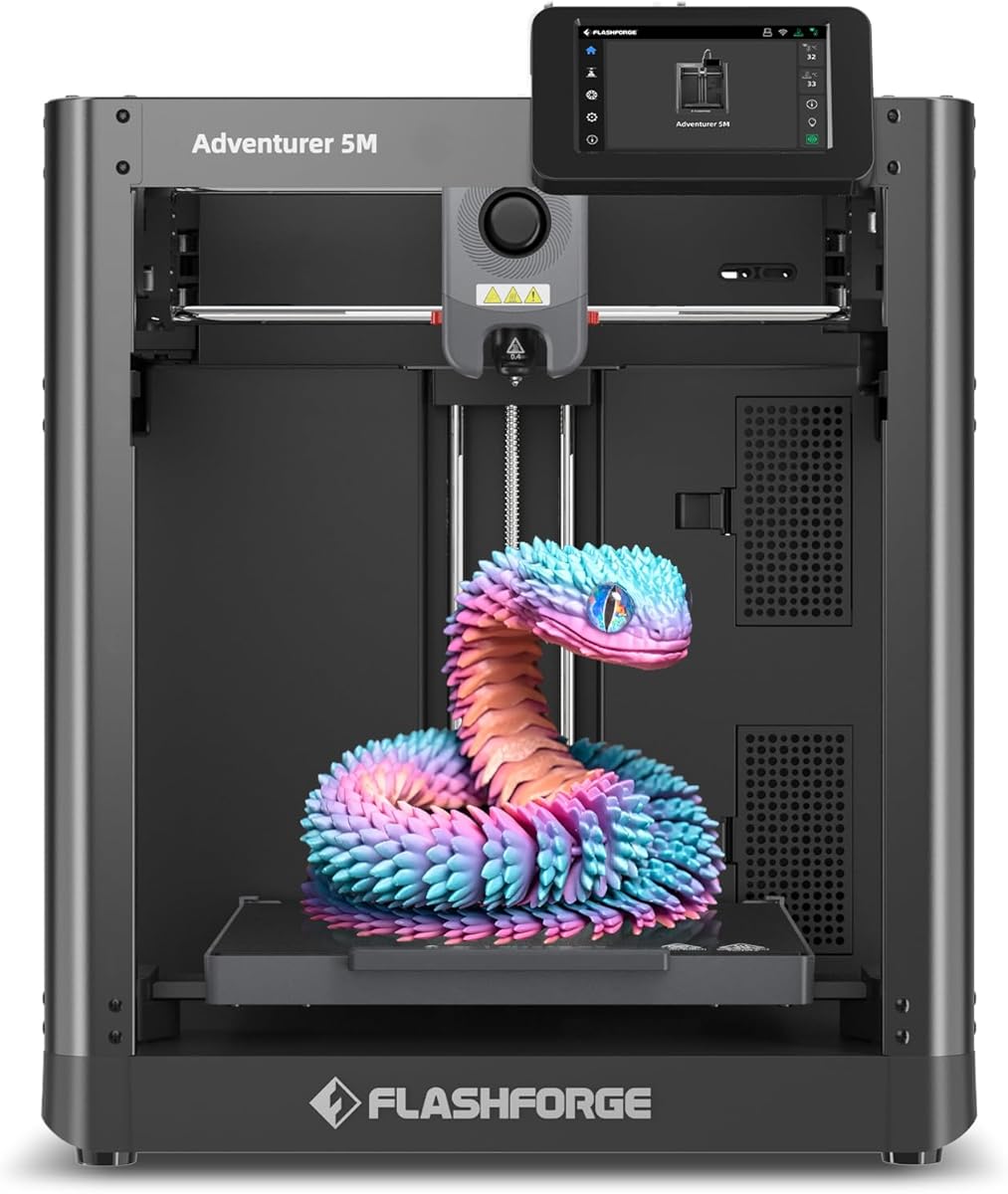
The FLASHFORGE Adventurer 5M offers impressive speed and auto-leveling features at a competitive price. Its CoreXY structure and 600mm/s speed make it ideal for rapid prototyping in educational settings.
We may earn a commission when you buy through this link, at no additional cost to you.
Features like the 3-second nozzle change and 280°C direct extruder provide versatility for various projects. The real-time app monitoring allows teachers to track multiple prints remotely without physical access.
The open frame design may not be suitable for all safety standards, and the lower user rating suggests potential setup quirks. However, for well-ventilated labs, it provides excellent performance per dollar.
This printer is best for advanced students needing high speed and precision. It balances efficiency with creative options, making it a strong contender for schools focused on engineering and design courses.
Max speed of 600mm/s and acceleration of 20000mm/s² reduce production cycles significantly.
Flash Studio app allows real-time progress tracking and setting adjustments from anywhere.
We may earn a commission when you buy through this link, at no additional cost to you.
The Bambu Lab P1S is a versatile workhorse with an enclosed design that supports advanced filaments like ASA and ABS. It delivers high-speed printing at 500mm/s with auto bed leveling for consistent results.
We may earn a commission when you buy through this link, at no additional cost to you.
Its 15-minute setup ensures teachers spend more time instructing and less time assembling. The enclosed body improves performance for temperature-sensitive materials, expanding project possibilities beyond PLA.
The main limitation is that multi-color printing requires a separate AMS unit. However, the core machine provides robust performance for standard educational projects and engineering prototypes.
Educators needing a reliable printer that handles diverse materials should choose the P1S. It balances ease of use with advanced capabilities, making it a favorite for high school and university labs.
Fully enclosed body improves print performance for advanced filaments like ABS and ASA.
User-friendly design ensures a hassle-free assembly experience for all skill levels.
We may earn a commission when you buy through this link, at no additional cost to you.
The FLASHFORGE AD5M combines high-speed printing with an all-metal CoreXY structure for stability. Its fully automatic one-click leveling system ensures accurate prints every time, reducing student frustration.
We may earn a commission when you buy through this link, at no additional cost to you.
Features like the quick-swap nozzle and power-loss recovery simplify maintenance and prevent wasted material. The Orca-flashforge slicer and Flash Maker APP allow remote monitoring and batch file transmission.
While the open design may require caution in classrooms, the robust construction ensures long-term reliability. The flexible PEI steel plate also aids in easy model removal, which is crucial for students.
This model is ideal for programs prioritizing precision and durability. It offers a professional-level experience at an accessible price point, making it suitable for secondary education and vocational training.
Durable design ensures high-speed printing without compromising quality or stability.
Orca-flashforge slicer enables one-click batch file transmission and multi-printer network monitoring.
We may earn a commission when you buy through this link, at no additional cost to you.
The Ugee Funbox is designed as a 3D printer for kids, featuring UL GREENGUARD certification and AI-powered creation tools. It arrives 100% assembled and pre-calibrated, so children can start printing immediately.
We may earn a commission when you buy through this link, at no additional cost to you.
Its AI engines turn text, photos, and voice into printable models instantly. With 15 fun studios and a built-in HD camera, students can learn design thinking while creating their own toys.
The single-color limitation encourages planning and assembly skills. The enclosed body with HEPA filters ensures a safe environment, making it ideal for elementary or middle school classrooms.
Educators focused on early STEM engagement will appreciate this model. It turns screen time into hands-on making, fostering creativity and problem-solving without the complexity of traditional printers.
UL GREENGUARD Gold certified with carbon filters reducing ultrafine particles for clean air.
AI engines convert text, photos, and voice into printable models instantly.
We may earn a commission when you buy through this link, at no additional cost to you.
The FLASHFORGE Adventurer 5M delivers ultra-fast 600mm/s speed with full-auto leveling for quality printing. Vibration compensation eliminates ghosting, ensuring smooth and no-blur prints for detailed models.
We may earn a commission when you buy through this link, at no additional cost to you.
Filament run-out and power loss recovery eliminate common interruptions. The dual-sided PEI coating plate supports various materials, providing flexibility for different curriculum projects.
Open frame design requires ventilation. However, the 10-minute setup from unboxing to printing ensures quick implementation in classrooms. It is a reliable tool for teaching design fundamentals.
Educators seeking high speed with straightforward operation will find this a strong choice. It offers consistent results and robust features without overwhelming beginners, making it great for introductory courses.
Vibration compensation eliminates ghosting for smooth and precise prints.
From unboxing to starting printing, only 10 mins are required.
We may earn a commission when you buy through this link, at no additional cost to you.
The Snapmaker U1 features a 4-toolhead system enabling true multi-color and multi-material printing. Its 5-second tool changer reduces waste and increases productivity for advanced educational projects.
We may earn a commission when you buy through this link, at no additional cost to you.
It supports engineering materials like ABS and ASA with a rigid CoreXY motion system. Smart calibration and AI-powered print monitoring ensure reliable prints with minimal manual adjustment.
While expensive, the ability to print functional parts with flexible materials and soluble supports is unmatched. It prepares students for professional-grade manufacturing workflows.
Educators looking to offer industry-level capabilities should consider this model. It combines speed with versatility, making it ideal for engineering programs and advanced technical education.
Combines rigid and flexible materials in a single print with no manual intervention.
Minimizes wasted material during filament changes by reducing filament waste by up to 5X.
We may earn a commission when you buy through this link, at no additional cost to you.
The Bambu Lab A1 Mini offers high-speed precision and full-auto calibration in a compact package. With a rating of 4.2, it delivers blazing-fast printing while maintaining exceptional accuracy for detailed prints.
We may earn a commission when you buy through this link, at no additional cost to you.
Its combo includes AMS lite for multi-color printing, unlocking vibrant designs. The setup for the first print takes just 20 minutes thanks to its pre-assembled design.
While the build volume is smaller, it is perfect for classroom demonstrations and small projects. The quiet environment with noise cancellation allows integration into shared spaces without distraction.
For programs needing multi-color capabilities without the footprint of larger models, the A1 Mini is ideal. It balances performance and size, making it a versatile tool for any educational setting.
AMS lite unlocks creativity with vibrant and multi-colored 3D prints.
Active motor noise cancellation ensures quiet operation for focused learning environments.
We may earn a commission when you buy through this link, at no additional cost to you.
Choosing the right 3D printer requires evaluating safety, ease of use, and performance. This guide breaks down the key factors to ensure your purchase aligns with your educational goals.
Safety is paramount in classrooms. Look for printers with enclosed bodies, UL GREENGUARD certification, or low-emission standards to protect students from fumes. These features prevent burns and ensure clean air.
Prioritize enclosed designs with filters if printing engineering materials or in unventilated spaces.
Time spent leveling beds is time lost teaching. Automatic bed leveling and auto calibration save significant effort. Choose models that allow students to start printing within minutes of unboxing.
Full-auto calibration ensures every print starts correctly without manual intervention.
Consider the available desk space and project types. Compact printers fit on individual desks but limit size. Larger builds support more complex projects but require dedicated areas.
Match the build volume to the typical size of student prototypes.
High speed reduces wait time, allowing students to iterate quickly. Printers with acceleration over 10,000 mm/s² offer rapid prototyping capabilities.
Fast printers ensure students can complete multiple iterations in a single class.
Multi-color printing enhances creativity but often requires extra hardware. Look for optional AMS or built-in changers if your curriculum emphasizes design and aesthetics.
Check if multi-color features are included or sold separately.
Some projects require engineering filaments like ABS or PETG. Ensure the extruder reaches high temperatures and the bed is compatible.
Verify supported materials before purchasing to match your curriculum needs.
Apps allow teachers to track multiple printers remotely. Look for models with user-friendly interfaces and cloud connectivity for seamless management.
Remote monitoring ensures safety and progress tracking without constant physical checks.
Robust construction reduces long-term costs. Metal frames and tool-free nozzle changes simplify maintenance. Choose printers designed for daily use.
Prioritize durability to handle high volumes of student usage.
Start by selecting the correct filament for your project. Ensure the nozzle temperature matches the material specifications before initiating the print job.
Regularly clean the build plate and check nozzle alignment to maintain consistent print quality. Power loss recovery features can help resume interrupted prints.
Store filament in dry places to prevent moisture absorption. Periodically update firmware for improved features and bug fixes.
The Ugee Funbox and Bambu Lab models offer enclosed designs with safety certifications. Always choose printers with UL GREENGUARD or low-emission ratings for indoor use.
Most modern educational printers like the Bambu Lab P1S require only 15 minutes. Models with auto-calibration are even faster, starting within minutes.
Yes, many support PLA, PETG, TPU, and ABS. Advanced models like the Snapmaker U1 can handle engineering-grade materials with special toolheads.
WiFi allows teachers to manage multiple devices from a central location. It is especially useful for large classes where monitoring each printer individually is difficult.
If your program focuses on design or advanced engineering, yes. Basic printing can be achieved with single-color models.
Most modern educational printers include power-loss recovery. They save progress and resume once power is restored to prevent wasted material.
The Bambu Lab A1 stands out as the best overall choice for its seamless integration of speed, safety, and ease of use. It provides the ideal balance for most school environments.
For smaller budgets, the Entina Tina2C offers a fantastic entry point with essential educational features. Schools prioritizing advanced capabilities might consider the P2S Combo for its professional-grade performance.
Remember that prices fluctuate frequently. Always verify current rates and features before purchasing to ensure the best value for your institution.