
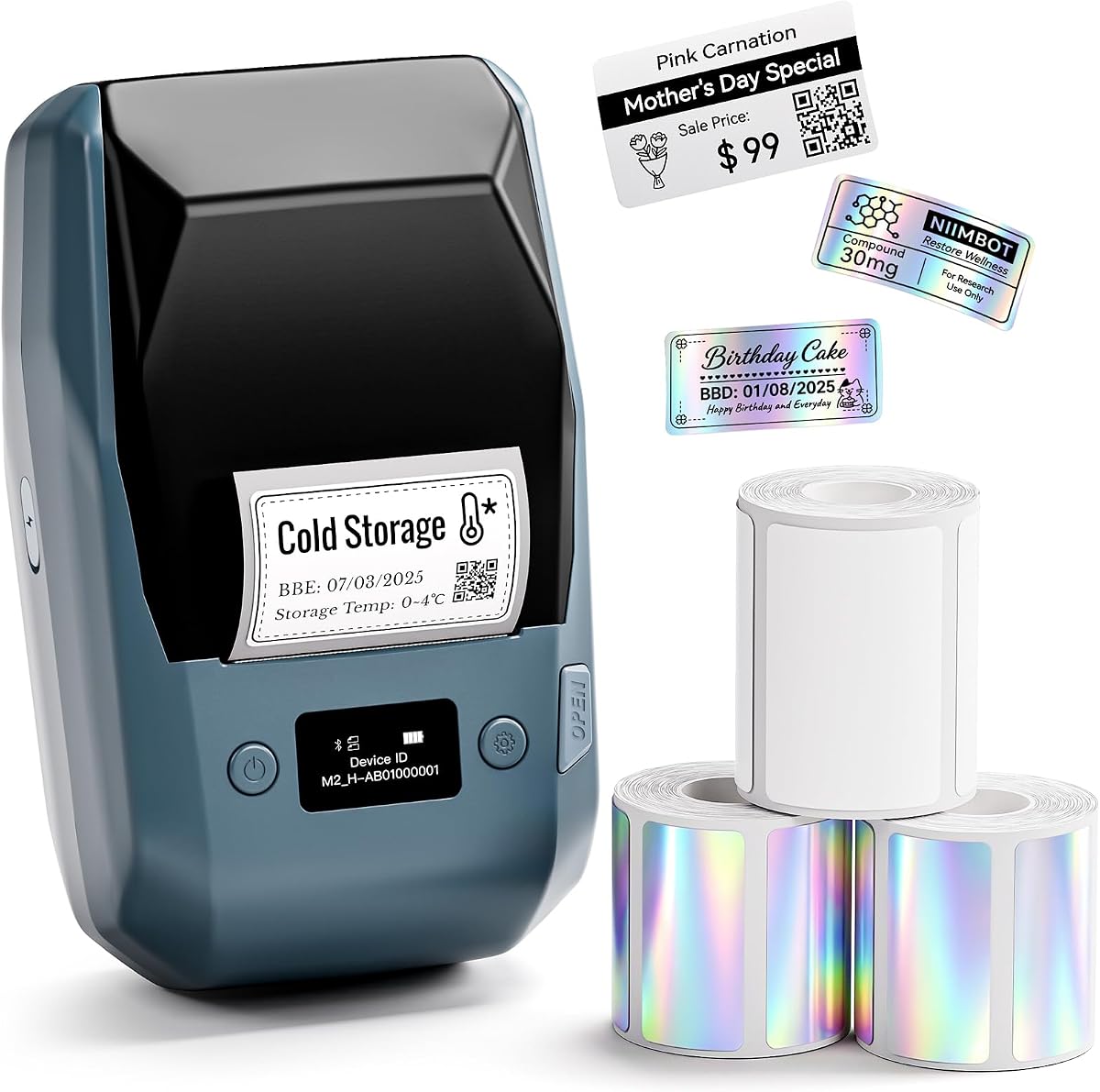
NIIMBOT B1 Label Maker Machine with 3 Tapes, 2Inch Thermal Label Printer
4.6Editor score
Direct thermal printing technology
Includes three rolls of tape
Portable rechargeable design
This comprehensive guide compares the top label printers for peptide vials, evaluating durability, print quality, connectivity, and resistance to harsh lab
Selecting the right label printer for peptide vials is crucial for maintaining sample integrity and ensuring accurate identification in laboratory settings.
We compared ten top-rated models based on print resolution, material durability, connectivity options, and specialized features for scientific and medical environments.
Each product overview highlights key strengths and ideal use cases, helping you find the perfect solution for your specific labeling needs and budget.
4.6Editor score

4.6Editor score

4.5Editor score
The following table provides a side-by-side comparison of all ten reviewed printers, highlighting their core specifications and unique selling points for laboratory use.


The NIIMBOT M2 stands out as the top choice for peptide vial labeling due to its advanced thermal transfer technology and robust durability.
We may earn a commission when you buy through this link, at no additional cost to you.
Its 300 DPI resolution ensures crisp barcodes and text that remain legible even after exposure to harsh lab conditions like alcohol or oil.
While the need for specific M2 labels adds a constraint, the longevity of the printed labels saves time and money in the long run.
This printer is ideal for research labs needing reliable, long-term identification for sensitive biological samples and storage containers.
The thermal transfer technology ensures labels withstand extreme temperatures and chemical exposure without fading.
300 DPI printing delivers sharp text and scan-ready barcodes essential for inventory tracking.
We may earn a commission when you buy through this link, at no additional cost to you.
This variant of the M2 offers a complete bundle with three rolls of tape, making it ready for immediate use upon delivery.
We may earn a commission when you buy through this link, at no additional cost to you.
It features the same robust thermal transfer technology and 300 DPI resolution, ensuring high-quality labels for peptide vials.
The inclusion of a VIP membership unlocks advanced app features, enhancing workflow efficiency for larger teams or busy labs.
Ideal for labs needing multiple labeling projects at once, this bundle provides excellent value and immediate usability.
Three rolls of tape ensure you can start labeling immediately without purchasing additional supplies.
Supports simultaneous pairing with up to ten mobile devices for efficient collaborative labeling.
We may earn a commission when you buy through this link, at no additional cost to you.
The NIIMBOT M2 with its 2000mAh battery offers extended operation time, perfect for long labeling sessions in busy laboratories.
We may earn a commission when you buy through this link, at no additional cost to you.
Its support for multi-material and multi-color ribbons allows for creating highly customized and visually distinct labels for various samples.
While it may be heavier than basic models, the added power and flexibility make it a reliable tool for complex labeling needs.
This model is recommended for labs requiring frequent use and varied label types, from clear to specialized materials.
A 2000mAh battery provides enough power for printing up to fifteen rolls on a single charge.
Supports multiple ribbon colors to create high-contrast labels for better visual identification.
We may earn a commission when you buy through this link, at no additional cost to you.
This M2 model emphasizes longevity, with printed labels remaining readable for up to ten years, ideal for long-term storage.
We may earn a commission when you buy through this link, at no additional cost to you.
Auto recognition features simplify the printing process by adjusting density automatically, saving users from manual adjustments.
While you must adhere strictly to M2-series labels, the result is a highly durable and fade-resistant labeling solution.
Best suited for archival storage or long-term sample tracking where label integrity is paramount.
Labels remain readable for 8 to 10 years, preventing data loss over time.
Adaptive print density matches material automatically, streamlining the printing workflow.
We may earn a commission when you buy through this link, at no additional cost to you.
The B1 Pro introduces dual color printing with red and black, allowing for distinct highlighting of critical information on vials.
We may earn a commission when you buy through this link, at no additional cost to you.
With a 300 DPI print head, it delivers sharp details for barcodes and text that are essential for quick scanning.
While it uses direct thermal which may not last as long as transfer, its visual impact is excellent for active lab use.
Recommended for labs needing visually distinct labels for categorization or urgent sample identification.
Red and black printing allows you to highlight warnings or priority samples effectively.
Access over 1500 icons and 200 fonts to create professional and custom labels easily.
We may earn a commission when you buy through this link, at no additional cost to you.
The SUPVAN T50M Pro offers an affordable entry point into thermal labeling, with a free app for easy editing.
We may earn a commission when you buy through this link, at no additional cost to you.
Its image processing capabilities are enhanced for clearer output, making it suitable for standard organization tasks.
While less specialized for harsh lab environments, it serves well for general office or light lab use.
Best for individuals or small labs with limited budgets needing basic identification solutions.
At an affordable price, it provides essential thermal labeling features without extra costs.
The free app requires no registration and offers easy tools for label customization.
We may earn a commission when you buy through this link, at no additional cost to you.
The NIIMBOT B1 is an ultra-compact portable printer that includes three rolls of tape, ready for immediate use.
We may earn a commission when you buy through this link, at no additional cost to you.
Its lightweight design makes it perfect for mobile lab work where you need to move around freely.
While it uses direct thermal which is less durable, the portability and battery life are significant advantages.
Ideal for field work or moving between stations where a small, reliable device is essential.
Weighing just 293g, this printer fits easily in pockets for on-the-go labeling.
A 1500mAh battery provides up to 100 days of standby time for uninterrupted use.
We may earn a commission when you buy through this link, at no additional cost to you.
The Brother PT-E510 is a premium industrial solution offering laminated labels for maximum durability and professional quality.
We may earn a commission when you buy through this link, at no additional cost to you.
Its dual auto-cutter simplifies the process of creating peel-and-apply labels, saving significant time in high-volume settings.
While expensive and desktop-bound, its robust features are unmatched for critical industrial or lab environments.
Best for large facilities or labs requiring high-volume, long-term, and highly durable labeling solutions.
Supports laminated labels that offer superior resistance to chemicals and physical wear.
The dual cutter enables quick creation of peel-and-apply labels for faster application.
We may earn a commission when you buy through this link, at no additional cost to you.
This Brother model combines industrial capabilities with wireless convenience, making it easy to design labels from mobile devices.
We may earn a commission when you buy through this link, at no additional cost to you.
Its support for mid-size labels and USB-C connectivity ensures it fits modern office and lab setups seamlessly.
While it lacks the dual cutter of its larger sibling, its Bluetooth feature enhances workflow flexibility significantly.
Recommended for labs needing a mix of industrial quality and wireless design capabilities for medium labeling jobs.
Use the Pro Label Tool app to design and print labels wirelessly from any mobile device.
USB-C charging and data transfer ensure compatibility with modern computers and power sources.
We may earn a commission when you buy through this link, at no additional cost to you.
The Seiko Smart Label Printer is a desktop solution focused on speed and ease of use with a front-loading design.
We may earn a commission when you buy through this link, at no additional cost to you.
It prints labels quickly at 2.76 inches per second, making it efficient for high-volume standard labeling tasks.
While it lacks advanced mobile features, its straightforward software and fast output are valuable for busy workspaces.
Best for labs needing a reliable, fast desktop printer for standard file and sample identification.
With a print speed of 2.76 inches per second, this printer handles large jobs quickly.
The front-load design makes changing rolls simple and intuitive without complex steps.
We may earn a commission when you buy through this link, at no additional cost to you.
Selecting the right label printer for peptide vials involves considering several critical factors to ensure sample integrity and operational efficiency.
Thermal transfer printers use ink ribbons to create durable, long-lasting labels that resist chemicals and abrasion, making them ideal for peptide vials. Direct thermal printers are cheaper but produce labels that can fade over time when exposed to heat or light, which may not be suitable for long-term storage.
For peptide vials that require long-term identification and exposure to harsh environments, thermal transfer technology is generally the superior choice.
Different printers support different types of label materials, including paper, plastic, and specialized chemical-resistant tapes. Ensure the printer you choose supports materials that can withstand the specific conditions of your lab, such as refrigeration, freezing, or solvent exposure.
Always check the manufacturer's recommendations for compatible label tapes to ensure the printer operates correctly and produces durable results.
Higher resolution (measured in DPI) ensures that text, barcodes, and QR codes are printed clearly and are easily scannable. For peptide vials, clear barcodes are essential for accurate inventory tracking and avoiding sample mix-ups.
Aim for a printer with at least 200 DPI resolution, though 300 DPI is preferred for professional lab environments to guarantee crisp text.
Labels in labs often face exposure to alcohol, oil, and other chemicals. A good printer for peptide vials should produce labels that are waterproof, oil-proof, and scratch-resistant.
Look for models explicitly marketed as having chemical resistance or suitable for medical and laboratory identification to ensure labels stay legible.
Modern label printers offer various connectivity options such as Bluetooth, Wi-Fi, and USB-C. Bluetooth allows for wireless printing from mobile devices, while USB provides a stable wired connection for desktop editing.
Choose a printer with connectivity that fits your workflow; if you use mobile apps for editing, ensure it supports both iOS and Android seamlessly.
Peptide vials vary in size, so the printer should support label widths that fit your containers comfortably, typically ranging from 20mm to 50mm.
Ensure the printer can accommodate the dimensions you need without frequent adjustments, which can slow down the labeling process.
Portable label printers rely on internal batteries, so battery life is crucial for uninterrupted work during long labeling sessions or fieldwork.
Look for models with high capacity batteries and efficient charging options like Type-C to minimize downtime and keep operations running smoothly.
A robust app with templates, barcode generators, and design tools simplifies the creation of professional labels. Advanced features like batch printing can save significant time.
Check if the app supports the features you need, such as importing data from spreadsheets or using custom icons for organization.
To begin, install the label tape or ribbon according to the manufacturer's instructions and ensure the printer recognizes the consumables. Connect your device via Bluetooth or USB and install any required drivers to establish communication.
Design your labels using the provided app or software, selecting appropriate templates for vial identification. Customize text to include necessary information like sample ID, date, and safety warnings to ensure clarity.
Regularly clean the print head and rollers with a soft cloth to prevent dust buildup that could affect print quality. Store the printer in a cool, dry place to protect internal components from moisture and temperature fluctuations.
Yes, thermal transfer labels are designed to resist chemicals such as alcohol, oil, and solvents, making them suitable for lab environments. However, always verify the specific resistance ratings of the label tape manufacturer before use.
Thermal printing uses heat-sensitive paper that can fade over time, while thermal transfer uses a ribbon to transfer ink onto the label, creating more durable and long-lasting results ideal for storage.
Measure the circumference or flat surface area of your vials and select a label width that fits comfortably without overlapping or curling. Most peptide vials work well with widths between 20mm and 50mm.
Modern Bluetooth printers are highly reliable for lab use, offering stable connections and flexibility to print from various devices. Ensure the printer supports both iOS and Android if you use different phones.
High-quality thermal transfer labels can last between 8 to 10 years depending on storage conditions and exposure to light or chemicals. They are much more durable than direct thermal labels.
Yes, most of these printers support barcode and QR code generation, which is essential for tracking sample inventory efficiently. The software usually includes tools to create and print these codes easily.
Choosing the right label printer for peptide vials is a critical decision that impacts sample tracking efficiency and laboratory safety.
Prioritize models with thermal transfer technology and high resolution to ensure labels remain legible and durable in demanding environments.
Always check current prices and availability to find the best deal that aligns with your specific laboratory requirements.