
Urban Worm Soil Thermometer
4.6Editor score
Five-inch stainless steel stem
Color-coded reading marks
Ideal for worm bins
This guide compares the top ten digital soil thermometer models for accurate temperature and moisture readings in gardens, lawns, and indoor plant care
Finding the right tool for garden care is essential for healthy plant growth. A digital soil thermometer provides precise readings to ensure your plants thrive in optimal conditions.
We evaluated ten leading models based on accuracy, ease of use, and durability. Our selection includes versatile testers for indoor pots, outdoor gardens, and composting needs.
Each review highlights key features, pros, and cons to help you decide. Prices and availability change frequently, so check the latest details before purchasing your next garden tool.
4.6Editor score

4.7Editor score

4.2Editor score
The following table provides a side-by-side comparison of all ten selected digital soil thermometers to help you identify the best fit for your specific gardening needs.




The YAMRON 4-in-1 stands out as a comprehensive tool for gardeners who want detailed soil insights. It holds a solid 4.2 rating and offers a unique combination of moisture, pH, temperature, and sunlight measurement. This versatility makes it a strong candidate for home growers looking to optimize plant health scientifically.
We may earn a commission when you buy through this link, at no additional cost to you.
Its standout quality lies in the 45-degree rotating head design which allows for comfortable viewing without bending over. The large LCD screen with white backlight ensures readability in any lighting condition. The probe technology from 2026 promises quick and accurate data, giving users confidence in their watering decisions.
However, users must be careful not to insert the probe into dry or hard soil, as this can damage the device. It also requires reading data from multiple locations to get an average, which adds a slight step to the process. These trade-offs are acceptable given the depth of information provided.
This device is ideal for hobbyists who want a single tool for multiple soil metrics. Whether managing a greenhouse or indoor potted plants, the YAMRON provides the necessary data to cultivate plants more scientifically and effectively.
The rotating head allows you to view the screen while keeping your posture comfortable during extended gardening sessions.
By measuring pH and sunlight alongside temperature, you gain a holistic view of your plants environment for better care.
We may earn a commission when you buy through this link, at no additional cost to you.
The Luster Leaf 1625 is a classic choice for gardeners who need a straightforward way to check soil warmth before planting. With a 4.2 rating, it is recognized for its reliability in determining if the soil is ready for early season planting or transplanting.
We may earn a commission when you buy through this link, at no additional cost to you.
Its primary strength is simplicity. There are no complex settings or batteries to replace. You simply push the probe into the ground and read the temperature. This makes it an excellent backup tool for those who prefer mechanical precision over digital complexity.
The main trade-off is that it only measures temperature. You will need a separate device if you want to check moisture or pH levels. However, for its specific purpose of checking soil warmth, it performs consistently well without any technological issues.
This thermometer is perfect for anyone who needs a quick, no-fuss check of soil conditions. It is an essential tool for early season planting to ensure seeds and seedlings are not planted in cold soil.
Knowing the exact soil temperature helps ensure that seeds germinate successfully and avoid wasting planting seasons.
The lack of digital components means there is nothing to break, making it durable for outdoor use in various conditions.
We may earn a commission when you buy through this link, at no additional cost to you.
The 7-in-1 Digital Soil Tester Kit offers a broad array of features that extend beyond simple temperature checking. With a 4.4 rating, it appeals to gardeners who want to monitor soil fertility through EC and TDS functions alongside standard moisture and pH levels.
We may earn a commission when you buy through this link, at no additional cost to you.
Its key strengths include the large LCD display with white backlight which makes reading data in dark greenhouses much easier. The 2025 probe technology ensures fast and accurate measurements, providing users with precise data to optimize their watering schedule effectively.
However, the probe requires moist soil to function correctly, meaning you may need to water the area slightly before testing. This is a standard limitation for probe-based testers but adds a small preparation step. The higher price reflects the additional fertility features it offers.
This tester is ideal for serious growers who need to track nutrient levels and soil health comprehensively. It is suitable for indoor and outdoor use, making it a versatile tool for gardens, beds, and potted plants.
The EC and TDS functions allow you to measure dissolved solids and conductivity for better nutrient management.
The extra-large screen and backlight ensure you can read values clearly even in low-light environments like dens.
We may earn a commission when you buy through this link, at no additional cost to you.
The Reotemp K83B1 is highly rated at 4.7 for its durability and specific focus on composting needs. It features a 12-inch stainless steel stem that reaches deep into piles to provide accurate temperature readings essential for effective compost production.
We may earn a commission when you buy through this link, at no additional cost to you.
Its standout quality is the high-quality construction with a corrosion-resistant 304 stainless steel case and glass lens. This makes it resistant to dust and water, ensuring it lasts through tough outdoor conditions. The included free digital composting guide adds significant value for beginners.
While it does not measure moisture or pH, its specialized design for soil and compost is its primary benefit. The glass lens is a point of caution as it can break if hit against hard objects. For most users, the durability is sufficient for typical compost bin use.
This thermometer is perfect for home composters who want to ensure their pile is heating up correctly. The long stem and rugged build make it a reliable tool for managing efficient compost production throughout the season.
The included guide offers expert instructions on how to manage your pile for the most efficient compost production.
The stainless steel case ensures the thermometer withstands the damp and active environment of a compost pile.
We may earn a commission when you buy through this link, at no additional cost to you.
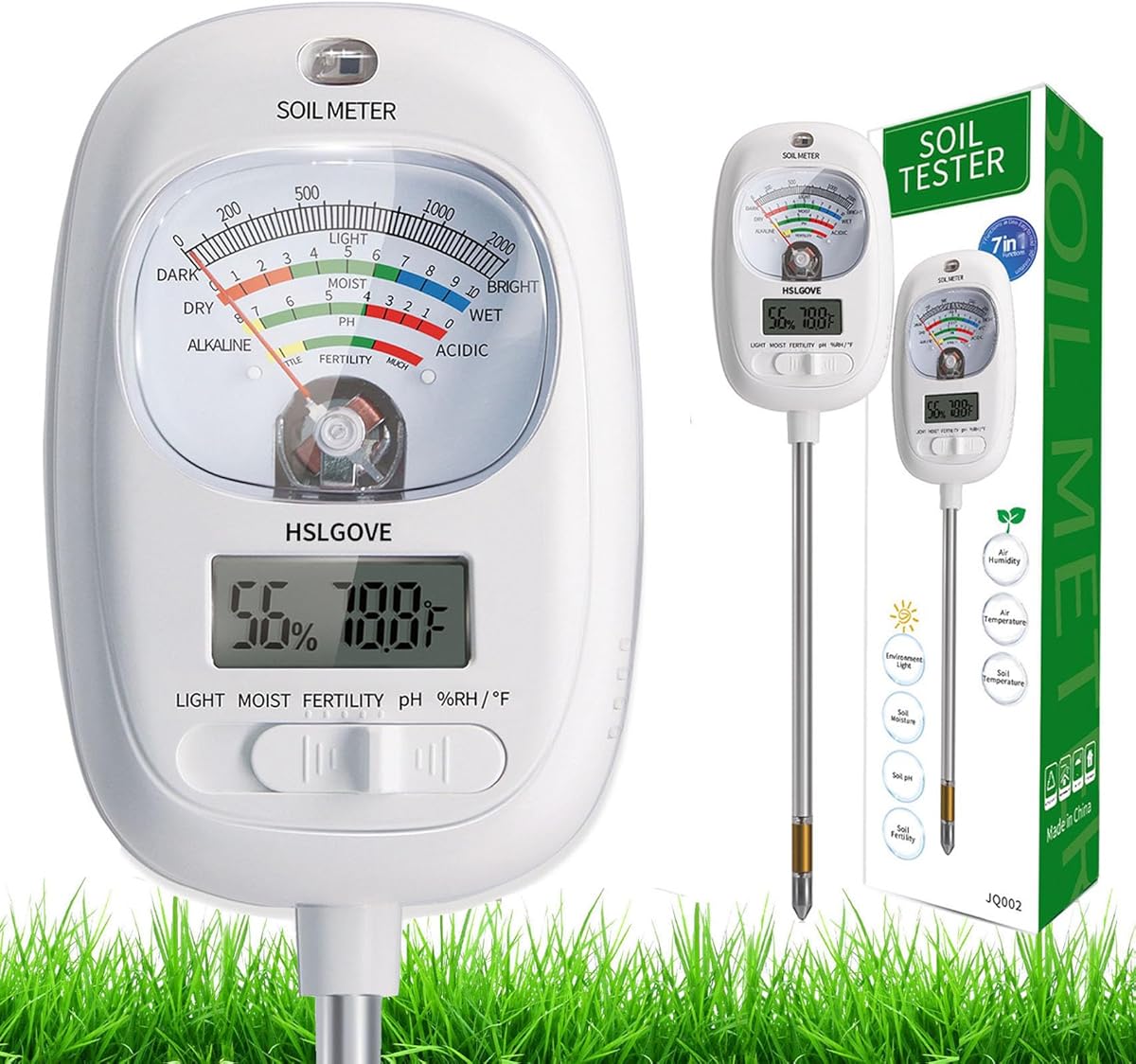
The HSLGOVE Soil Test Kit is designed to offer a comprehensive view of both soil and air conditions. With a 4.4 rating, it features a unique dual-screen design that displays soil metrics alongside indoor temperature and humidity for a complete environmental snapshot.
We may earn a commission when you buy through this link, at no additional cost to you.
Its key strengths include the patented dual-dial design which allows for simultaneous monitoring of soil and air data. The three-metal probe system is robust and accurate, capable of analyzing medium to large potted plants effectively without causing excessive root disturbance.
One trade-off is that you must replace all three batteries each time one runs low, which can be slightly inconvenient. Additionally, like many probes, it is not designed for liquid testing. These minor issues are outweighed by the depth of data provided.
This kit is ideal for indoor gardeners and those managing seedlings who need precise control over temperature and humidity. The easy-to-use button switching allows for quick results to help cultivate lush and healthy plants.
The combination of soil and air sensors allows for a complete understanding of the plant's growing environment.
The three metal probe design ensures durability and accurate data without harming the plant's root system during testing.
We may earn a commission when you buy through this link, at no additional cost to you.
The Urban Worm Soil Thermometer is a specialized tool designed for vermicompost enthusiasts. With a 4.6 rating, it is highly valued for its easy-to-read green, yellow, and red tick marks that indicate the ideal temperature range for worms.
We may earn a commission when you buy through this link, at no additional cost to you.
Its key strength is its simplicity and focus. It allows you to quickly see if worms are in the ideal 55F to 90F range without complex numbers. The 5-inch stainless steel stem is the perfect depth for monitoring worm compost effectively.
The trade-off is that it only measures temperature and has a limited depth. This is acceptable for worm bins where depth is shallow. It offers great value for its specific purpose and ensures the health of your composting worms.
This thermometer is perfect for anyone managing a worm bin who wants to avoid overheating or freezing their worms. It is a specialized tool that makes monitoring worm health effortless and effective.
Monitoring temperature helps you know when to cool off the bin or move it to a warmer place to keep worms happy.
The color-coded system removes the need to interpret numbers, allowing for instant checks of bin conditions.
We may earn a commission when you buy through this link, at no additional cost to you.
The ECOWITT WN34BS stands out as a premium choice for tech-savvy gardeners. With a 4.2 rating, it offers a sensor with a 11.8 inch probe that provides real-time data on soil temperature with advanced wireless capabilities.
We may earn a commission when you buy through this link, at no additional cost to you.
Its key strength is the ability to view live data on the Ecowitt App or website when paired with a GW1100 Wi-Fi gateway. This allows for remote monitoring and email alerts if the temperature changes, ensuring your plants are protected from sudden weather shifts.
The trade-off is the requirement for a separate gateway which adds to the cost and setup complexity. However, for large gardens or professional setups, this connectivity provides a level of control that standalone thermometers cannot match.
This sensor is ideal for farms or large lawns where checking temperatures manually is time-consuming. The long transmission range and waterproof design make it a reliable choice for outdoor use over long periods.
Email alerts ensure you know immediately if soil temperatures drop or rise to dangerous levels for your crops.
The app allows you to view history records and graphs to understand trends over time for better planning.
We may earn a commission when you buy through this link, at no additional cost to you.
The Digital Soil EC Meter focuses on electrical conductivity to provide insight into salt content and nutrient levels. With a 4.1 rating, it is designed for users who want to ensure their soil has the right balance of nutrients for healthy plant growth.
We may earn a commission when you buy through this link, at no additional cost to you.
Its key strengths include the temperature compensation function (ATC) which ensures accurate readings regardless of soil temperature. The IP67 waterproof electrode and backlight LCD display make it robust for outdoor use and easy to read in dim light.
The trade-off is that it requires an optional calibration solution to maintain accuracy, adding a step to the process. It also does not measure moisture or pH directly. These details are necessary for maintaining the precision of EC measurements.
This meter is ideal for hydroponic growers or those who fertilize heavily and need to track nutrient density. It helps you better understand your soil's nutrient content for better planting and harvesting results.
Measuring electrical conductivity helps you detect excess salts that might harm your plants over time.
The temperature compensation ensures that readings remain accurate even if the soil is cold or warm.
We may earn a commission when you buy through this link, at no additional cost to you.
The EDGEVEIL 4-in-1 is a unique system that allows for wireless monitoring of plants from a distance. With a 4.5 rating, it combines moisture, temperature, light, and clock data on a single screen, reducing the need to walk from pot to pot.
We may earn a commission when you buy through this link, at no additional cost to you.
Its key strengths include the wireless range of up to 328 feet and the ability to monitor up to 12 plants from one display. The triple-probe TDR technology provides stable and consistent readings that do not disturb the roots when left in place.
The trade-off is that the probe stays in the soil, which might not be desirable for all plant types. Additionally, managing multiple sensors can be complex. However, for large collections, this wireless capability offers unmatched convenience.
This system is ideal for busy plant owners who want to check conditions from their couch or office. It helps reduce overwatering and underwatering by providing clear alerts and real-time data for every plant.
The ability to check plants from across your home means you can monitor them even in bad weather.
The triple-probe design allows the sensor to remain in the soil without causing constant disturbance to roots.
We may earn a commission when you buy through this link, at no additional cost to you.
The 7 in 1 Soil Meter is a heavy-duty tool designed to withstand tough and compacted soil. With a 3.9 rating, it features a five-probe system that offers faster and more precise data compared to standard two-probe meters.
We may earn a commission when you buy through this link, at no additional cost to you.
Its key strengths include the split HD display which makes it easy to read real-time data without crouching. The corrosion-resistant materials ensure long-term service life even in commercial farms or backyard flower pots.
The trade-off is that the setup steps for pH reading can take time to ensure accuracy. Additionally, it is more expensive than basic models. However, the durability and precision justify the cost for serious growers.
This meter is ideal for commercial farms or greenhouses that need robust and expandable monitoring. It is built to last and supports advanced features like hydroponic substrate testing for diverse growing needs.
The premium materials ensure the tool withstands long-term outdoor exposure without losing sensitivity or breaking.
The split design allows you to monitor multiple parameters simultaneously without needing to switch modes constantly.
We may earn a commission when you buy through this link, at no additional cost to you.
Choosing the right digital soil thermometer depends on your specific gardening needs and the environment where you plan to use it.
Consider what data you need beyond temperature. Some models only measure heat, while others offer moisture, pH, light, and fertility data. A 4-in-1 or 7-in-1 kit provides more comprehensive insights but may be more complex to use.
If you are focused on planting times, a temperature-only tool is sufficient. For indoor plant care, a combination of temperature, moisture, and light is often more valuable.
Probe length varies significantly. Shorter probes work well for pots, while longer stainless steel stems are necessary for compost piles or deep garden soil. Look for corrosion-resistant materials to ensure the probe withstands damp environments.
A rotating or flexible probe head can improve comfort during use. Ensure the probe is durable enough for your specific soil type without bending or breaking.
A large LCD screen with backlight is essential for reading data in shaded areas or low light. Some models offer split displays or visual indicators like color-coded marks for quick interpretation of soil status.
Digital displays with clear numbers are easier to read than analog dials. Backlights ensure you can check readings at night or in dim greenhouses without straining your eyes.
Standard probes require you to stand next to the soil. Wireless models allow you to place the probe in the ground and read data on a separate screen or app from a distance.
Wireless systems are convenient for large gardens but often require a separate receiver or gateway. Wired models are simpler and usually cheaper but require physical access to the sensor.
Look for waterproof and dust-proof ratings like IP65 or IP67 if you plan to use the device outdoors frequently. This ensures the electronics survive rain and humidity.
Stainless steel cases and corrosion-resistant probes are crucial for long-term use. A durable build prevents damage from accidental drops or harsh weather conditions.
Some devices use batteries that need frequent replacement. Others may have built-in power options. Check if batteries are included or need to be purchased separately.
Low-battery alerts are a helpful feature that prevents unexpected device failure. Standard AAA batteries are common and easy to replace for most models.
Simple devices with one-button operation are easier for beginners. Complex models with calibration steps may require more effort to maintain accuracy.
Instructions and manuals should be clear. Tools that provide intuitive icons or color codes help you understand soil conditions quickly without studying a chart.
Some thermometers are designed for specific uses like worm compost or hydroponics. Ensure the device matches your gardening style.
Additional features like composting guides or humidity monitoring add value but increase the cost. Weigh these extras against your primary needs before buying.
To get accurate readings, ensure the soil is moist before inserting the probe. Dry soil can lead to incorrect measurements or damage to the sensor tip.
Insert the probe about 4 to 10 inches deep into the soil. Wait for about 10 seconds to allow the temperature and moisture levels to stabilize before reading the display.
After use, clean the probe with a soft cloth to remove dirt. Store the device in a dry place to prevent corrosion and ensure the batteries last longer.
Many models come pre-calibrated, but EC meters may require a calibration solution for accuracy. Check the manual for specific steps before first use.
Most soil thermometers are designed for soil or moist soil only. Submerging the probe in water may damage the electronics unless specified.
Check temperatures weekly during planting season or whenever you adjust watering schedules to ensure plants are healthy.
Soil moisture and pH probes generally need some moisture to function. Dry soil can result in inaccurate readings or sensor damage.
Insert the probe at least 4 inches deep to get a reliable reading. For deep soil or compost, aim for 10 to 12 inches.
Fluctuations can happen if the probe is not fully inserted or if the soil is uneven. Wait a few seconds for the reading to stabilize.
Yes, digital soil thermometers are great for succulents to ensure they do not stay in cold or overly damp soil.
Some models allow continuous monitoring, but others are designed for spot checks. Check the device instructions before leaving it in place.
We found that the Reotemp K83B1 is excellent for composters, while the ECOWITT WN34BS offers advanced monitoring for tech users. The Urban Worm Thermometer is a great budget option for vermicompost enthusiasts.
Prioritize the features that match your specific gardening tasks. A versatile 7-in-1 kit is useful for complex setups, but a simple thermometer may suffice for basic planting checks.
Remember that prices and availability can change frequently. Always check the latest details and current models before making your purchase to ensure you get the best value.