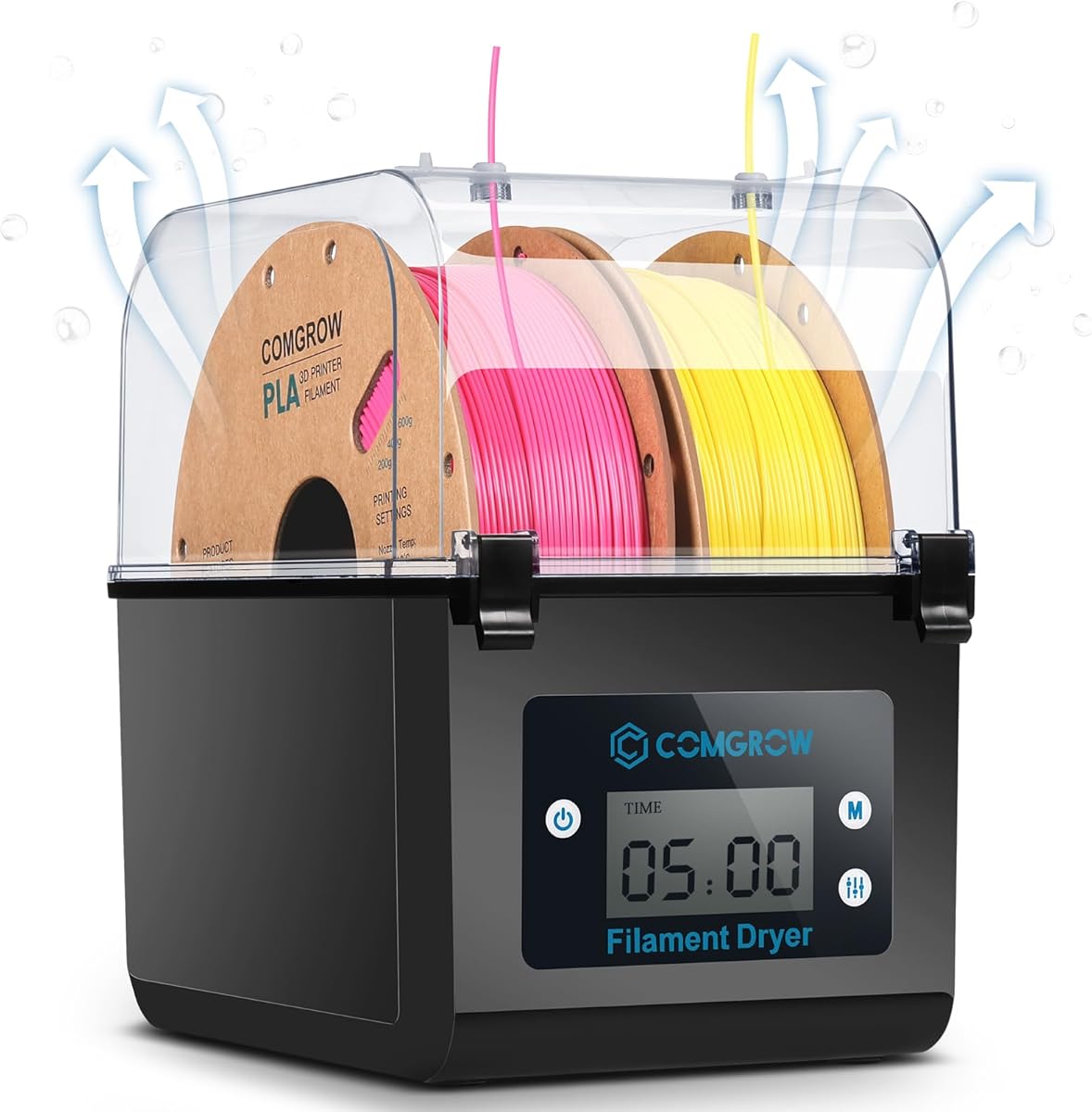
Comgrow 3D Printer Filament Dryer Box SH01
4.4Editor score
Holds two 1kg spools
50C max temperature
LCD touch control panel
Discover the top filament dryer for 3D printing options to eliminate moisture issues. This guide compares features, capacity, and performance for all major
Moisture in 3D printing filament causes stringing, clogging, and weak layers. A quality filament dryer for 3D printing removes humidity effectively to ensure consistent extrusion and professional results for every print job.
We evaluated ten leading filament dryers based on capacity, heating speed, temperature control, and sealing quality. Our analysis covers budget-friendly boxes to high-volume dual-chamber systems for serious makers.
Each pick highlights unique strengths like touch screens, multiple spool slots, and real-time humidity monitoring. Note that product prices fluctuate frequently so check current listings before purchasing your ideal dryer.
4.4Editor score

4.6Editor score

4.5Editor score
This side-by-side comparison details specifications and features across all ten selected filament dryers to help you find the perfect match for your 3D printing workflow and budget requirements.



The Creality Space Pi X4 stands out with dual heating chambers and high capacity. It holds four standard 1kg spools while drying them efficiently up to 85 degrees Celsius. This makes it ideal for professional users managing multiple filament types.
We may earn a commission when you buy through this link, at no additional cost to you.
Its dual independent 200W heaters remove moisture 30 percent faster than single chamber dryers. The touch UI allows precise temperature customization from 50 to 85 degrees. An illuminated window lets you monitor spools without breaking the seal.
While effective for high volumes, it occupies significant desk space. The cost is higher than single spool units but justified by the speed and capacity. It suits multi-printer setups or workshops needing bulk preparation.
Investors buying this dryer gain extended filament life and consistent print quality. It is recommended for advanced makers who need reliable moisture control for ABS and PC materials.
Independent chambers ensure even drying across multiple spools without temperature drops.
Reaching 85 degrees allows drying of advanced engineering filaments like Nylon and Polycarbonate.
We may earn a commission when you buy through this link, at no additional cost to you.
The Comgrow SH01 offers essential drying features at an accessible price. It stores two 1kg spools and maintains temperatures up to 50 degrees. This is sufficient for PLA PETG and ABS materials in home studios.
We may earn a commission when you buy through this link, at no additional cost to you.
Its 2-inch LCD screen provides clear display of set times and temperatures. The silicone cable sheath at the outlet prevents moisture re-entry during printing. Snap buttons on the cover ensure a tight seal when not in use.
Lacking a humidity sensor requires manual timing for dryness. The 50 degree limit prevents use with high temp engineering filaments. However it reliably handles common hobbyist needs without complexity.
Budget conscious users will find this dryer delivers essential protection against moisture. It is a practical choice for printers who need dry filament without advanced diagnostics.
This unit brings drying capability to new users at a minimal investment.
Snap buttons and silicone tubes maintain dryness between print sessions effectively.
We may earn a commission when you buy through this link, at no additional cost to you.
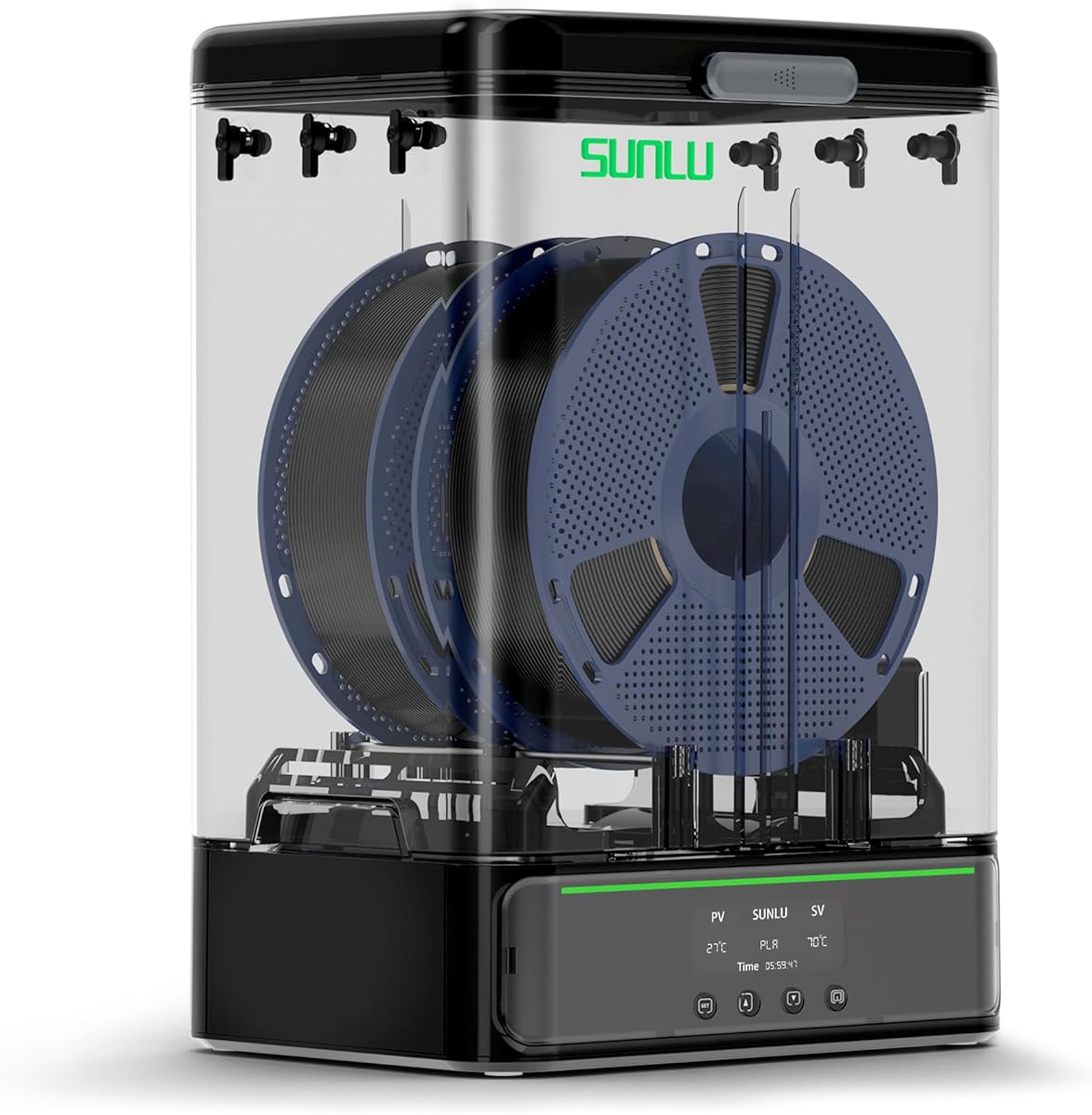
The SUNLU S4 delivers professional performance with a 350W PTC heater. It circulates air via three fans to ensure even drying across four 1kg spools. Eight exit holes allow feeding multiple printers simultaneously.
We may earn a commission when you buy through this link, at no additional cost to you.
Internal dimensions offer ample room for various spool sizes. Users can set timers up to 99 hours for extended maintenance. The system supports all common filament types and diameters seamlessly.
At four kilograms this dryer is heavy and requires stable placement. Setup involves managing multiple PTFE tubes for feeding. These trade-offs are acceptable for serious users needing high throughput.
This dryer suits farms or labs requiring consistent moisture control. The premium build and heating efficiency justify the investment for professional 3D printing operations.
Three circulation fans create uniform temperature distribution for reliable drying.
Eight exit holes facilitate feeding multiple machines from one drying unit.
We may earn a commission when you buy through this link, at no additional cost to you.
The SUNLU S1 Plus introduces fan-assisted drying to speed up moisture removal. It fits one standard spool and displays temperature and humidity on a 2-inch LCD. This model is ideal for small desktop setups.
We may earn a commission when you buy through this link, at no additional cost to you.
Upgraded fan design accelerates evaporation compared to passive heating. Temperature range extends to 55 degrees for ABS compatibility. The interface uses hold and press buttons for simple adjustments.
Limited to single spool capacity it suits solo printers. Power is lower than large units so drying times may extend. It remains a reliable daily driver for common PLA and PETG needs.
Desktop users needing a compact solution should consider this dryer. Its balance of size and function makes it a practical choice for home makers.
Fan assistance reduces drying times and improves efficiency.
Touch and hold buttons simplify parameter changes for any user.
We may earn a commission when you buy through this link, at no additional cost to you.
The Creality Space PI Plus combines drying and humidity monitoring in a dual spool box. A 110W PTC heater circulates 360-degree hot air for uniform drying. The 3.7-inch touch screen simplifies operation with presets.
We may earn a commission when you buy through this link, at no additional cost to you.
One-key settings cover 12 filament types including composites like PA-CF. Timers run up to 48 hours for flexible scheduling. This ensures filaments remain dry and ready for immediate use.
The display allows switching between Celsius and Fahrenheit easily. While power is moderate it suits mid-range users needing reliability. It lacks the massive capacity of X4 but offers smart features.
Printers valuing touch interface and humidity data will appreciate this model. It fits well in studios requiring quick setup for varied filament materials.
One-key settings reduce manual input for different filament types.
Real-time monitoring helps track drying progress accurately.
We may earn a commission when you buy through this link, at no additional cost to you.
The Polymaker Polydryer focuses on seamless transition from drying to printing. It features a hygrometer to monitor internal humidity directly. Users can feed filament without exposing it to ambient moisture.
We may earn a commission when you buy through this link, at no additional cost to you.
Heated drying combines with sealed storage and desiccant containers for defense. This multi-layer approach protects sensitive materials like Nylon and PA. The box supports standard diameters and common brands.
Moving the spool from dryer to printer avoids moisture reabsorption. It simplifies workflow for professionals managing moisture sensitive resins. The unit lacks advanced heating power but prioritizes protection.
Anyone prioritizing filament safety should consider this integrated system. It bridges storage and drying effectively to maintain print readiness.
Direct feeding avoids opening the dryer and losing dryness.
Heat plus seal plus desiccant offers complete moisture control.
We may earn a commission when you buy through this link, at no additional cost to you.
The Creality Space PI SE heats quickly to 65 degrees within 15 minutes. It uses a precision sensor and thermal insulation to maintain consistent chamber temperature. A simple knob interface makes setting limits straightforward.
We may earn a commission when you buy through this link, at no additional cost to you.
Internal cotton insulation prevents heat loss and protects users from burns. The display shows humidity and countdown timer for tracking progress. It supports 1kg spools and fits most filament diameters.
This unit balances speed and control well for home makers. Setup requires no assembly and works immediately from the box. It suits users preferring simple interfaces over complex touchscreens.
For those needing rapid pre-drying before prints this model delivers. It is a solid choice for consistent PLA and PETG maintenance.
Quick heating reaches target temps in under 15 minutes.
Thermal cotton keeps exterior cool during operation.
We may earn a commission when you buy through this link, at no additional cost to you.
The SUNLU S4 Black offers a 350W heater and four spool slots for bulk drying. It ensures consistent temperature with three circulation fans and 360 heating. Eight exit holes allow feeding multiple machines at once.
We may earn a commission when you buy through this link, at no additional cost to you.
Users can set timers up to 99 hours for continuous drying. The large internal space accommodates 1kg and larger rolls. It supports all standard diameters and common 3D printing materials.
Physical footprint and weight require sturdy placement. Setup involves organizing multiple tubes for feeding. These factors trade convenience for high throughput capabilities.
Workshop users managing large fleets of printers will find this essential. It guarantees dry filament for demanding production schedules.
Four spool slots maximize drying efficiency per cycle.
350W power ensures fast and uniform drying.
We may earn a commission when you buy through this link, at no additional cost to you.
The SUNLU SP2 reaches 70 degrees in 15 minutes via a 250W PTC element. It includes a detachable storage box to maintain dryness after drying. Real-time humidity monitoring ensures conditions are optimal.
We may earn a commission when you buy through this link, at no additional cost to you.
Six silicone holes and two PTFE tubes provide flexible feeding options. The HD LCD screen displays all critical metrics clearly. It supports up to 3kg spools for large format users.
Detachable design simplifies transport and storage. While slightly pricier than single spool models it adds long value. It suits users needing speed and sealed storage.
This dryer is ideal for high volume users requiring fast turnaround. Its quick heat and robust sealing protect prints from moisture.
250W power brings target temps in just 15 minutes.
Detachable box allows for easy storage after drying.
We may earn a commission when you buy through this link, at no additional cost to you.
The SUNLU S2 features a large touchscreen for easy parameter setting. Its built-in spindle rotates filament for even drying without static. A translucent lid allows visual checks without opening the unit.
We may earn a commission when you buy through this link, at no additional cost to you.
Timers and temperatures are customizable from 0 to 99 hours and 35 to 70 degrees. This flexibility suits various materials and ambient humidity levels. It supports 1.75mm to 3.00mm diameters.
Lacking humidity sensors it relies on user timing. It is effective for reviving damp filament and preventing print issues. A simple tool for those prioritizing user-friendliness.
New to dryers will appreciate this intuitive interface. It simplifies maintenance for standard 3D printing tasks.
Large screen allows quick changes to settings.
Translucent lid enables monitoring without breaking seal.
We may earn a commission when you buy through this link, at no additional cost to you.
Selecting the right dryer requires assessing capacity, temperature range, and control features. This guide explains key factors to consider before purchasing.
Choose a dryer that fits your workflow. Single spool units suit hobbyists while multi-spools serve workshops. Consider if you need to dry while printing.
Match spool count to your printer count.
Ensure the max temp supports your materials. PLA needs 45C while Nylon needs 70C. Verify the device reaches your highest needed temp.
Select units with adjustable settings for versatility.
PTC heaters warm up faster than resistive coils. Look for 15 to 30 minute warm-ups. Faster heating saves energy and prep time.
Prioritize PTC for efficiency.
Silicone seals prevent moisture re-entry during printing. Check for snug lids and cable ports. A good seal maintains dryness between jobs.
Inspect seals for tightness before buying.
Touchscreens offer convenience but knobs are durable. Consider usability for older makers. LCDs help monitor humidity and temps.
Pick an interface you can use daily.
Ensure the unit supports your filament diameter. Most work with 1.75mm to 3mm. Check for specific material presets if needed.
Verify compatibility with your filament types.
Higher wattage means faster drying but uses more electricity. Balance speed with cost. Typical units range from 100W to 350W.
Check wattage if power usage matters.
Larger units hold more but take space. Consider desk size and stability. Heavy units require secure placement to avoid tipping.
Measure space before purchasing large units.
Place the dryer on a stable surface near your printer. Connect it to power and plug the filament outlet into your printer or drybox. Set the temperature based on your filament type.
Set the timer for 12 to 48 hours depending on moisture level. If your model has humidity monitoring check the display for low readings. Replace desiccants regularly to maintain effectiveness.
After drying, keep the lid closed to preserve dryness. Use silicone plugs for unused outlets. Clean the interior occasionally to remove dust. This keeps performance consistent.
Most units accommodate 1.75mm to 3.00mm diameters. Check the product specifications for diameter limits. Some boxes have fixed rollers that fit specific sizes.
Frequency depends on humidity and storage. Dry every week in humid climates. Use dryers to dry after long periods of inactivity.
Yes you can use it for storage and drying only. It acts as a dehydrator and moisture proof container. This protects filament when not printing.
It is helpful for precise monitoring. Not all units include it. Users can dry by time if no sensor exists.
Avoid exceeding max temps like 50C for PLA. Overheating can deform spools. Set temps carefully using presets.
Wipe interior with a dry cloth. Ensure vents are clear of dust. Do not use water or liquids inside.
The Creality Space Pi X4 and SUNLU S4 offer top performance for high capacity needs. Comgrow SH01 stands out for those seeking a budget-friendly option.
Prioritize temperature range and sealing when selecting. These features protect your filament from moisture related print failures.
Check current prices and availability before purchasing to ensure you get the best value for your setup.