
SOLPERK Solar Panel Kit 20W
4.5Editor score
Includes smart charge controller
Corrosion-resistant aluminum frame
Adjustable mounting bracket included
This guide compares the top marine solar panels for 2026, evaluating efficiency, durability, and shading resistance to help boaters choose the right power
Marine solar panels are essential for keeping your boat batteries charged during long voyages or when docked. They provide reliable renewable energy to power electronics, navigation systems, and onboard appliances without relying on generators.
We compared ten top-rated solar panels based on efficiency, build quality, and performance in marine environments. Our analysis focuses on real-world usability, including shading resistance, weatherproofing, and compatibility with standard marine electrical systems.
Each pick highlights specific strengths for different boating needs, from compact trickle chargers to high-output rigid arrays. Note that availability and specifications may change, so verify details before purchasing to ensure compatibility with your vessel.
4.5Editor score

4.8Editor score
4.6Editor score
The following table provides a side-by-side comparison of the ten selected marine solar panels. It highlights key specifications and features to help you quickly identify the best match for your boat's power requirements and available mounting space.


The Callsun 200W bifacial panel stands out as a top choice for marine applications requiring high efficiency and reliability. With a rating of 4.8 stars, it delivers exceptional performance through its advanced N-type cells and bifacial design. This setup allows for energy capture from both the front and rear, maximizing output even in varied lighting conditions.
We may earn a commission when you buy through this link, at no additional cost to you.
Its twin-cell anti-shading design is a major advantage for boats where rigging or masts might cast shadows. By dividing the panel into two independent sections, it ensures that partial shading does not cripple the entire system. The low temperature coefficient further ensures stable power generation during hot summer days on the water.
While the price point is higher than basic options, the investment pays off in long-term energy reliability and reduced degradation. The tempered glass and IP68 junction box provide the necessary protection against salt spray and harsh weather. The only trade-off is the physical footprint, which may not suit smaller vessels with limited deck space.
Boaters seeking maximum power for large battery banks or off-grid living should consider this panel. It is ideal for those who need consistent energy without relying on generators. Ensure your boat has the mounting area and structural support before installation to fully benefit from its capabilities.
Captures sunlight from both sides to increase overall power output, especially useful when mounted on reflective boat surfaces.
The dual-module design keeps power flowing even if part of the panel is shaded by masts or cabin structures.
We may earn a commission when you buy through this link, at no additional cost to you.
The SOLPERK 20W kit offers an accessible entry point for boaters looking to add solar power without a large investment. Rated at 4.5 stars, it provides a complete solution with the panel, controller, and mounting hardware included. This makes it exceptionally easy for beginners to start maintaining their boat batteries with renewable energy.
We may earn a commission when you buy through this link, at no additional cost to you.
Its main strength lies in its simplicity and cost-effectiveness. The included 8A controller prevents overcharging, protecting your battery investment. The adjustable mounting bracket allows you to angle the panel for optimal sun exposure, which is crucial for small output panels. It is perfect for keeping batteries topped up during storage or short trips.
However, the 20W output is limited for powering larger appliances or running high-draw systems. It is best suited for maintenance and trickle charging rather than primary power generation. The build quality is solid for the price, but heavy-duty marine conditions may require extra care to ensure longevity.
This kit is ideal for small runabouts, tenders, or as a backup system for larger boats. If your goal is simply to prevent battery drain during downtime, this is a practical choice. Install it on a clear spot on the deck or bimini to get the best results without complex wiring.
Includes panel, controller, and bracket so you have everything needed to start charging immediately.
The 360-degree adjustable bracket helps you position the panel at the best angle for sun exposure.
We may earn a commission when you buy through this link, at no additional cost to you.
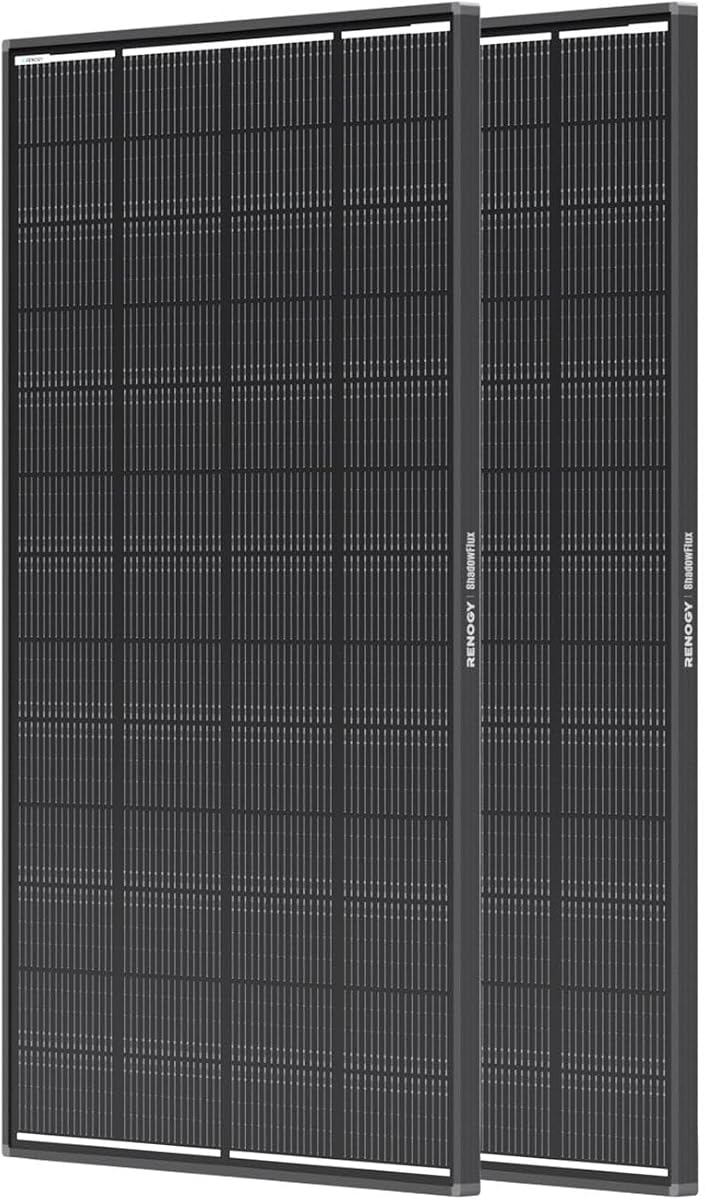
The Renogy 400W ShadowFlux panel represents a top-tier option for serious boaters needing robust power independence. With a 4.6 rating, it combines high efficiency with innovative shading technology to ensure consistent output. Its N-type cells and compact design make it a standout choice for those maximizing limited roof space.
We may earn a commission when you buy through this link, at no additional cost to you.
ShadowFlux technology is a key feature, reducing power loss when parts of the panel are shaded by boat structures. This is critical on sailboats or vessels with tall masts where shadows are common. The 25% efficiency rate ensures you get more power per square foot compared to older technologies, making it highly efficient.
While the cost is higher, the reliability and warranty support justify the expense for long-term marine use. The IP67 rating protects against water and dust, essential for salty ocean environments. The trade-off is the price and the need for a charge controller capable of handling high voltage and current inputs.
Choose this panel if you need to power large inverters, water makers, or heavy electronics while underway. It is best paired with a comprehensive marine solar setup including batteries and an inverter. Verify your existing electrical system can handle the 400W input to avoid compatibility issues.
Minimizes power loss from partial shading caused by masts, rigging, or cabin structures on your boat.
Delivers 400 watts while being smaller than traditional panels, perfect for limited roof areas.
We may earn a commission when you buy through this link, at no additional cost to you.
The SUNER POWER 20W charger combines a solar panel with an integrated MPPT controller for smart battery maintenance. Rated at 4.4 stars, it uses Ultra-Smart MPPT technology to maximize charging efficiency. This makes it an excellent choice for maintaining various battery types on boats without complex external wiring.
We may earn a commission when you buy through this link, at no additional cost to you.
Its visual charging indicators provide clear feedback on battery status, helping you monitor the system easily. The three selectable charging modes allow you to optimize performance for AGM, Lithium, or standard lead-acid batteries. The built-in safety features prevent overcharging and reverse polarity, protecting your expensive marine batteries.
While the 20W output is not enough for powering systems, it is perfect for keeping batteries healthy during idle periods. The waterproof design ensures it can handle rain and spray on deck. However, the suction cup mounting may not be as secure as fixed brackets for long-term offshore use.
Ideal for weekend boaters or those storing boats in the winter, this unit ensures your battery stays ready for use. Connect it directly to your battery terminals or use the alligator clips for temporary setups. It is a reliable tool for preventing deep discharge in smaller boats.
Delivers up to 99% tracking efficiency, ensuring more solar energy reaches your battery compared to PWM controllers.
Switch between 12V, AGM, and Lithium modes to match your specific battery type safely.
We may earn a commission when you buy through this link, at no additional cost to you.
The Renogy 100W panel offers a reliable balance of power and efficiency for mid-sized boats. With a 4.7 rating, it utilizes advanced N-type cells to deliver 25% efficiency. This makes it a strong performer for daily power needs, from lighting to small electronics, without requiring a massive array.
We may earn a commission when you buy through this link, at no additional cost to you.
Its low temperature coefficient ensures stable performance even in hot climates, which is common for boaters. The IP67 rating protects the junction box and cells from rain and dust, essential for marine environments. The 25-year performance guarantee provides peace of mind regarding long-term reliability and durability.
While efficient, it is a rigid panel that needs a flat mounting surface, which may not fit curved boat roofs. Ensure you have the proper mounting holes or brackets before installation. The power output is sufficient for charging batteries but may require multiple units for high-load systems.
Choose this panel for cruisers or sailboats needing consistent daily charging. It is a standard choice that works well with most marine charge controllers. Pair it with a battery bank sized for your needs to maximize the benefits of this efficient solar technology.
Provides 25% conversion efficiency, delivering more power than standard panels in the same space.
IP67 protection ensures the panel can withstand harsh marine weather conditions and long-term exposure.
We may earn a commission when you buy through this link, at no additional cost to you.
The Renogy ShadowFlux 200W panel is designed to overcome common challenges like partial shading on boats. Rated at 4.5 stars, it uses advanced anti-shading technology to maintain power output even when parts of the panel are blocked. This makes it particularly useful for vessels with complex rigging or cabin structures.
We may earn a commission when you buy through this link, at no additional cost to you.
Its N-type cells provide 25% efficiency, ensuring high energy conversion. The compact design allows it to fit into spaces where larger panels might not work. The IP67 rating protects against environmental hazards, ensuring the panel performs well in rain, salt spray, and other marine conditions.
While the price is slightly higher than standard models, the anti-shading capability often justifies the cost. It reduces the risk of underperforming when the sun is not directly overhead. The trade-off is the need to ensure you have the right mounting brackets for secure installation.
Ideal for sailboats or powerboats with obstructed roof spaces, this panel ensures reliable energy. Use it as a primary or secondary source depending on your power needs. Check your battery capacity to match the output, and ensure your charge controller can handle the voltage.
Reduces power loss when shaded by masts or rigging, ensuring consistent energy generation.
Delivers 200 watts in a smaller footprint than standard panels, perfect for limited deck space.
We may earn a commission when you buy through this link, at no additional cost to you.
The Renogy Flexible 200W panel is perfect for boats with curved surfaces that rigid panels cannot fit. Rated at 4.5 stars, it can bend up to 240 degrees, allowing installation on curved cabins or bimini tops. This flexibility maximizes usable roof space where rigid panels would not conform.
We may earn a commission when you buy through this link, at no additional cost to you.
It uses half-cut PERC cell technology to enhance efficiency and light capture. The panel is significantly lighter than rigid options, reducing weight on your vessel. The IP67 rating protects the junction box from water, though care must be taken not to exceed the bending limits during installation.
While flexible, it may not be as durable as rigid panels against impact or heavy loads. Handle it with care to avoid micro-cracks. It is best suited for permanent adhesive mounting or specific flexible panel brackets. The output is consistent for powering small to medium systems.
Choose this for catamarans or boats with curved tops. It provides power where other options fail. Ensure the surface is clean before applying adhesive for a secure bond. Verify your charging system is compatible with flexible panel output characteristics.
Bendable design fits curved cabin tops or bimini frames where rigid panels cannot be mounted.
Weighs less than half a rigid panel while using advanced PERC cells for high output.
We may earn a commission when you buy through this link, at no additional cost to you.
The Renogy 120W ShadowFlux panel combines high power with a compact footprint. With a 4.5 rating, it uses ShadowFlux technology to resist shading effects. This makes it a strong choice for boats needing reliable power but lacking space for larger panels.
We may earn a commission when you buy through this link, at no additional cost to you.
Its N-type cells deliver 25% efficiency, ensuring maximum energy from available sunlight. The compact design makes it easy to integrate into smaller setups or add as an expansion to an existing system. The IP67 protection ensures durability against marine weather conditions.
While the price is premium, the anti-shading capability and efficiency make it cost-effective over time. It performs well even when part of the panel is obstructed. Ensure you have proper mounting brackets, as hardware is not always included with rigid panels.
Ideal for auxiliary power or as a main panel on smaller boats. It is versatile enough for various marine applications. Check compatibility with your charge controller to ensure optimal charging efficiency. Proper placement on your boat will maximize its 120W output.
Delivers enhanced power even when shaded, making it reliable on boats with complex structures.
Provides 120W in a smaller footprint than traditional panels, saving valuable deck space.
We may earn a commission when you buy through this link, at no additional cost to you.
The SUNER POWER 50W charger offers a step up in power compared to smaller trickle chargers. Rated at 4.4 stars, it includes a smart MPPT controller to optimize battery charging. This makes it a great choice for maintaining larger 12V battery banks or supporting small auxiliary loads.
We may earn a commission when you buy through this link, at no additional cost to you.
Its visual charging indicators provide clear feedback on battery status. The selectable charging modes allow for flexibility with different battery chemistries. The waterproof design ensures it can handle rain and spray when mounted on deck. Safety features prevent overcharging and short circuits.
While 50W is more than 20W, it is still best for maintenance rather than primary power. It can handle light loads but is not intended for running high-draw electronics continuously. The suction cup mounting is easy but may need reinforcement for high-wind conditions.
Ideal for mid-sized boats needing a reliable maintenance solution. It ensures your batteries stay healthy during storage or short trips. Connect it securely to terminals to avoid connection issues. It is a practical investment for boat owners looking for reliable battery care.
Provides more power than standard 20W maintainers, suitable for larger 12V battery banks.
Intelligently tracks power to maximize charging efficiency and protect battery health automatically.
We may earn a commission when you buy through this link, at no additional cost to you.
The POWOXI 7.5W charger is an entry-level option for basic battery maintenance. Rated at 4.4 stars, it offers a simple way to keep batteries topped up during storage. While small, it provides essential protection against deep discharge for boats or equipment left unused.
We may earn a commission when you buy through this link, at no additional cost to you.
It features a smart protection system to prevent overcharging and short circuits. The LED indicators show charging status clearly. The ABS+PC frame offers durability and scratch protection. It is lightweight and easy to move between different battery locations as needed.
However, the 7.5W output is minimal, suitable only for very small batteries or as a backup. It is not intended for powering any systems. Ensure the panel gets direct sunlight to be effective. The convenience of plug-in connections makes it user-friendly for quick checks.
Best for small boats or as a secondary charger in your toolkit. It ensures your battery stays in top condition when off the water. Verify the connection points fit your battery terminals securely. It is a budget-friendly option for keeping batteries ready.
Built-in blocking diode and protection system prevent battery damage from overcharging or short circuits.
LED lights show whether the panel is receiving sunlight and charging the battery properly.
We may earn a commission when you buy through this link, at no additional cost to you.
Choosing the right marine solar panel depends on your boat's size, energy needs, and available space. This guide breaks down key factors to help you make an informed decision for your vessel.
Determine your daily energy consumption in watt-hours to select a panel size that can recharge your battery bank effectively. Larger boats with more electronics need higher wattage panels or multiple panels wired together.
For maintenance, a smaller 20W to 50W panel suffices, while primary power needs may require 100W to 400W systems.
Rigid panels are generally more durable and efficient, making them ideal for flat roof mounting. Flexible panels are useful for curved surfaces like bimini tops but may have lower durability over time.
Choose rigid panels for stability and long-term performance, or flexible ones if you have unique mounting constraints.
Boats often have shadows from masts or cabins, so look for panels with anti-shading technology like bypass diodes or split cells. This ensures power continues even if part of the panel is shaded.
Prioritize panels with advanced anti-shading tech if your boat has significant obstructions that block sunlight regularly.
Marine environments are harsh, so ensure the panel has high waterproof ratings like IP67 or IP68 for the junction box. Corrosion-resistant frames are essential for salty air and spray.
Look for tempered glass and aluminum frames designed to withstand wind, salt, and UV exposure for long life.
Consider how the panel will be mounted. Fixed brackets offer stability but may limit angles, while adjustable mounts allow for sun tracking. Ensure the mounting hardware is included or compatible with your deck.
Secure mounting is critical to prevent movement in rough seas, so choose brackets that fit your specific boat structure.
Ensure your charge controller matches the panel type. MPPT controllers are more efficient but cost more. PWM controllers work for smaller systems but may waste energy.
Check voltage and current compatibility between the panel and controller to avoid system failures or reduced efficiency.
Reputable brands offer warranties ranging from 10 to 25 years. Look for coverage on power output and materials. Good customer support is essential for resolving issues.
Invest in brands with strong warranty backing to protect your investment and ensure long-term reliability for your marine setup.
Cost varies significantly from budget 20W kits to high-end 400W systems. Balance your needs with your budget, considering long-term value over initial cost.
Higher quality panels may cost more upfront but save money by reducing replacement needs and increasing energy reliability.
Clean your solar panels regularly with freshwater to remove salt, dirt, and debris that can block sunlight and reduce efficiency. Use a soft cloth or sponge to avoid scratching the surface, especially for flexible panels.
Check all connections and wiring periodically for signs of corrosion or wear. Ensure cables are securely fastened and protected from chafing against sharp edges on the boat.
Store the panels or system indoors during extreme weather conditions if possible. Avoid placing heavy objects on the panels and ensure mounting points remain tight to prevent damage from wind or waves.
Yes, marine solar panels still generate electricity in cloudy conditions, though at reduced efficiency. They capture diffused sunlight, so expect lower output compared to direct sun. MPPT controllers can help maximize performance in low light.
This depends on your daily energy usage and available roof space. Calculate your total watt-hours per day and divide by average sun hours. For maintenance, one 50W panel may suffice, but for primary power, consider 200W or more.
Yes, flexible solar panels are designed to bend and fit curved surfaces. However, ensure you do not exceed the bend radius to avoid damaging the internal cells. Secure them properly to prevent lifting in wind.
An inverter is needed if you want to convert DC power from panels to AC power for household appliances. If you only power 12V DC devices, you can use the panels directly with a charge controller and battery.
Position panels in areas least likely to be shaded or use panels with anti-shading technology. Consider installing multiple smaller panels spaced apart so if one is shaded, others continue to work.
Most quality marine solar panels last 25 years or more with proper care. Degradation occurs slowly over time, so expect slight efficiency loss annually. Regular cleaning and maintenance extend their functional life.
We reviewed ten top marine solar panels ranging from budget trickle chargers to high-output systems. The Callsun N-Type panel stands out for efficiency, while Renogy and SUNER POWER offer reliable options for different needs.
Prioritize your specific power requirements and available space when selecting a panel. Ensure compatibility with your existing battery and charge controller setup to avoid complications.
Prices and availability can change, so verify the latest details before purchasing. Investing in quality solar ensures reliable power for your boat adventures.